12th February 2026
Reflections on From Inactivity to Independence: Measuring the Impact of Movement in Adult Social Care
It's always a thrill to hear about outstanding work emerging from Lincolnshire. This week, we were both delighted and proud to read the newly-published white paper From Inactivity to Independence: Measuring the Impact of Movement in Adult Social Care, which describes the pioneering work of Bailey Greetham-Clark and Be Great Fitness, and which was produced in collaboration with Care England and Lincoln Healthcare Partnership Primary Care Network.
The paper makes a powerful, evidence-based case for structured, meaningful movement as a driver of better health, wellbeing, dignity, and confidence for older adults in care settings.
The approaches the paper describes go far beyond traditional notions of “exercise” or “reablement.” Instead, it aligns closely with the principles set out in Our Shared Agreement and its Five Foundations:
- Foundation 1: Being prepared to do things differently
- Foundation 2: Understanding what matters to ourselves and each other
- Foundation 3: Working together for the wellbeing of everyone
- Foundation 4: Conversations with and not about people
- Foundation 5: Making the most of what we have available to us
In the reflections that follow, we explore how the paper's themes align with personalised, strength-based care, and why this work holds real promise for shaping the future of adult social care across Lincolnshire.
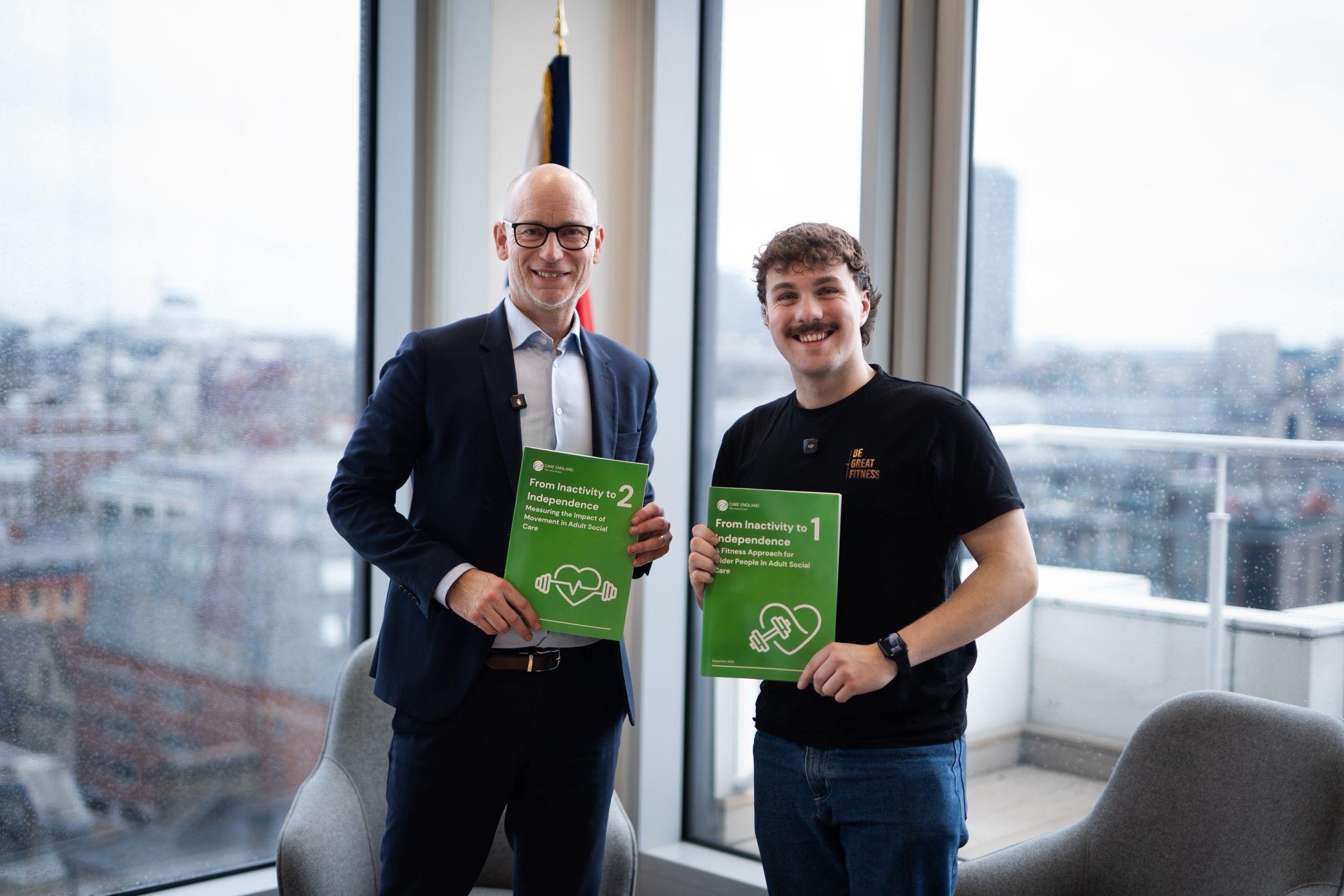
Bailey Greetham-Clark, presenting From Inactivity to Independence to Stephen Kinnock MP, Minister for Care. Click on the link in the side panel to watch Bailey's interview with Stephen Kinnock.

The core message: People first, not tasks
At its heart, From Inactivity to Independence reaffirms what we advocate in our personalisation work: people are not passive recipients of care but active partners in shaping how care happens.
The paper clearly challenges the idea that physical and functional decline is inevitable, instead asking:
“Mobility and wellbeing must no longer be treated as optional enhancements to care…” - reframing movement as a fundamental part of people’s wellbeing rather than an extra.
This resonates closely with Our Shared Agreement, where the focus is on moving beyond “problems and processes” and concentrating on “strengths, hopes, and what truly matters most to people”.
In person-centred care practice, we are guided to see people first, not their conditions, and this paper supports that lens by looking at residents’ lived experiences, motivations, barriers, and aspirations, rather than just clinical metrics.
Strengths-based approaches: What people can do
A central theme throughout the paper is how activity was framed around abilities, not deficits. Instead of measuring people against standardised physical targets, practitioners asked:
“What can we do, as opposed to what can’t we do?”
This shift is squarely in line with strengths-based approaches - interventions that focus on helping people achieve their highest possible independence in the context of their own lives, networks, and aspirations.
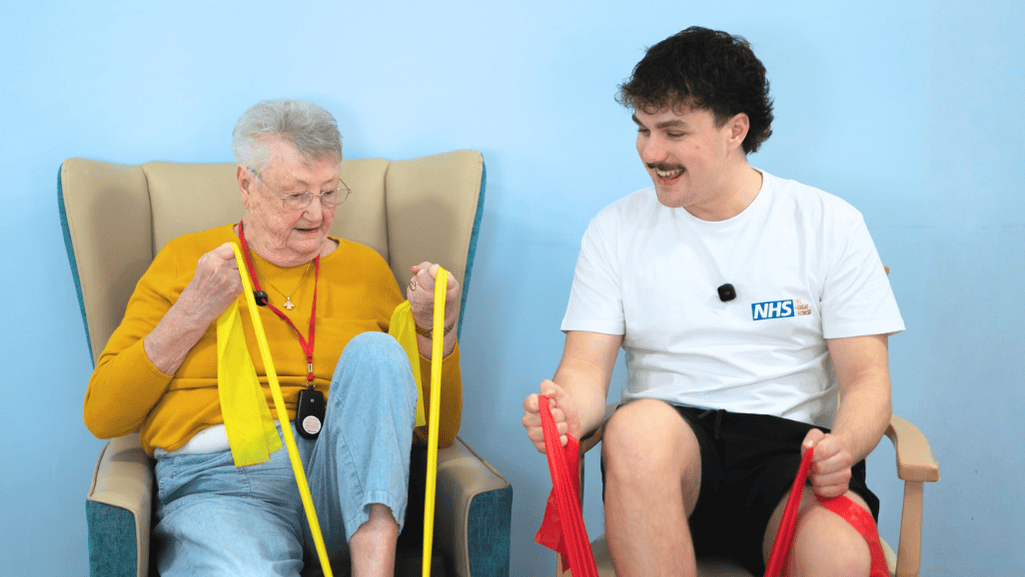
Bailey Greetham-Clark with care home resident during an activity session
This means:
- Recognising each individual’s potential and building on it
- Designing movement from within people’s lived routines rather than imposing an external standard
- Creating experiences that are meaningful, enjoyable, and purposeful
This theme echoes Foundation 2: Understanding what matters to ourselves and each other, which calls us to learn deeply about each person’s perspective before acting.
By working in this way, the paper shows us that people who might otherwise be labelled as “too frail” or “too dependent” can indeed benefit, and flourish, when supported in strength-based ways.
Relational practice: Moving with, not doing to
One of the most powerful insights from the paper is that the quality of relationships matters as much as the activity itself.
Residents engaged more fully when sessions were delivered with curiosity, respect, and relational skill, when staff took time to connect, joke, encourage, and genuinely work alongside people.
This mirrors Foundation 4: Conversations with and not about people, a principle that repeatedly arises in personalisation work. It is not enough to inform people about what will happen to them. Instead, we must listen, co-produce, and act together.
Rather than transactional interventions, what residents experienced were human moments that:
- acknowledged their experience
- invited participation rather than 'compliance'
- built confidence and agency
Thinking, acting, and practising in this way moves us away from the outdated paradigm of care as something done to people and towards care as something done with people.
Collaboration and shared decision-making
The paper highlights how movement programmes were most successful when they were co-produced with residents, family members, and care teams.
In line with Foundation 3: Working together for the wellbeing of everyone, the interventions were not isolated tasks delivered by a professional. Instead, they were co-owned initiatives:
“Residents, family members, staff, and local teams all brought their strengths and knowledge together to shape what happened.”
This collaborative approach echoes what we know from our personalisation work: that when the people who use services are treated as equal partners in decision-making, the outcomes are more relevant, sustainable, and empowering.
Co-production doesn’t just make interventions more effective. It shifts power, builds trust, and strengthens relationships across the care ecosystem.
Embedding practice across systems
While the paper rightly focuses on the impact at resident and team level, it also contains themes that point to system-wide transformation, something central to the aims of both the It’s All About People Personalisation Programme and Our Shared Agreement.
For example, there is clear alignment with:
- Foundation 1: Being prepared to do things differently, which encourages openness to change, patience, and learning through doing, especially when long-held assumptions are challenged.
- Foundation 5: Making the most of what we have available to us, which invites us to use the skills, relationships, and networks already present in communities, not just the medical or clinical “solutions” alone.
The evidence in the paper suggests that embedding personalised, strength-based movement supports:
- improved wellbeing and confidence for residents
- enhanced confidence and satisfaction for staff
- reduced reliance on emergency responses and medication
- more predictable, collaborative care environments
These outcomes clearly speak to a much broader purpose: sustainable, human-centred systems that balance quality, dignity, and resource stewardship.
Active intelligence: Measuring what matters
The paper also highlights the importance of measuring what matters, capturing data in ways that reflect what matters to people, moving away from purely clinical indicators and toward measures of:
- confidence
- independence
- quality of life
- connection
Being prepared to measure what matters aligns strongly with our personalisation practice, where we encourage workforce teams to gather evidence that reflects real human outcomes, not just task completion or risk reduction.
This echoes a fundamental principle of personalisation: data should serve people, not define them.
Conclusion: From insights to shared action
From Inactivity to Independence is more than an evaluative study. It's a powerful affirmation of what many of us have long believed: that strengths-based, person-centred approaches lead to more meaningful, impactful care.
By,
- prioritising what matters to each person
- building with people, not for them
- recognising and growing people’s strengths
- embedding relational, collaborative practice
- and rethinking what “success” looks like
this paper demonstrates a model of care that is both deeply humane and practically effective, aligning clearly with the Five Foundations of Our Shared Agreement.
As the Personalisation Programme team, we see this work as part of a broader shift, away from assumptions of decline and toward belief in capabilities. Away from task-centred care and toward co-produced person-centred support.
From Inactivity to Independence helps lift the lid on what’s possible when people are met where they are, seen as partners in change, and supported to live with confidence and connection.
For those of us working to embed personalisation across health and care in Lincolnshire, and beyond, this can be a source of inspiration, a validation of strengths-based practice, and a call to action to keep building systems that truly put people at the centre.
We look forward to continuing this work, sharing learning across communities, and spreading approaches that support independence, dignity and shared wellbeing for everyone.


