24th January 2026
Reimagining the Continuing Healthcare journey: Reflections at the end of the Process Mapping phase
Over the past ten weeks, colleagues from across Continuing Healthcare (CHC), Adult Social Care and partner organisations in Lincolnshire have come together to do something both simple and brave: pause, look closely at how the CHC journey really works, and ask how it could work better for the people at the heart of it.
The CHC process mapping project was born from a shared recognition that while Continuing Healthcare provides vital, fully NHS-funded support for people with complex needs, the experience can sometimes feel complicated, clinical, and impersonal. At a time when individuals and families are often under immense pressure, the system can feel more focused on forms and frameworks than on people.
As Helen Sands, Head of All-age Continuing Healthcare, put it at the outset, the ambition was clear: to reimagine CHC so it becomes “more personal, more compassionate, and more connected,” ensuring that real and lasting improvements are felt by both those who receive care and those who deliver it.
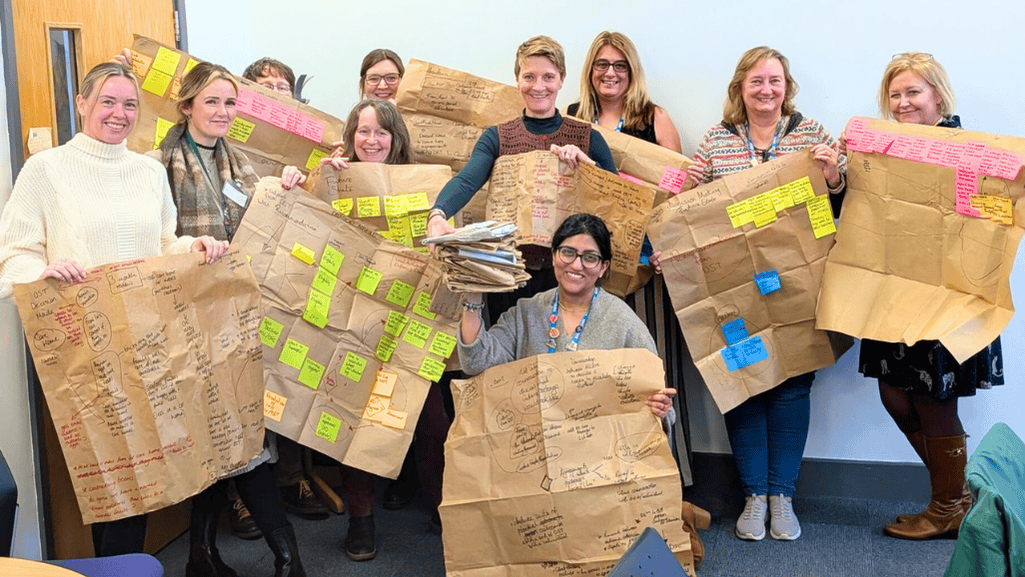

Pictured above (left to right): Vicky Lee and Laura Orton (Lincolnshire County Council Adult Social Care), Gavin, Caty, Alison, Kirsteen, and Shibina (It's All About People Personalisation team), Helen Sands, Paula Elding, and Lisa Wishart-Wormald (All Age Continuing Care, NHS Lincolnshire Integrated Care Board)

Why Process Mapping, and why now?
Before the workshops began, conversations with CHC staff revealed some recurring challenges. Team members spoke openly about how the pathway can become task-driven, how communication can break down between services, and how limited time makes it hard to build trust and rapport with people and families. There were also different interpretations of what “personalised care” really means in practice, and frustration about how national policy can limit flexibility.
Rather than trying to “fix” these issues in isolation, the decision was made to take a whole-system view.
Over ten weeks, twelve facilitated sessions explored seven key themes, mapping the CHC journey from first conversations about eligibility through to reviews and disputes. Crucially, this wasn’t a paper exercise. It was a chance to listen, challenge, and think differently together.
From processes to people
One of the strongest themes to emerge was a collective shift in mindset: away from rigid processes and towards people.
Lisa Wishart-Wormald, Deputy Head of All Age Continuing Care Business Administration and ICB Lead for Personal Health Budgets, described this change vividly:
“What really stood out to me was the shift from a set mindset of doing things a certain way to seeing people open up to new possibilities… The main point is that we went from process focused to person focused.”
This reframing helped participants ask new questions. Not just What happens next in the process? but Where is the person in this? and How does this feel for them? One pivotal moment during a mapping session came when someone asked, “We’ve not mapped the touch points with people in this process – where are they?” That question now underpins the design of the future state of the CHC pathway.
Lightbulb moments and honest reflection
The workshops created space for honest reflection, and for many participants, powerful “lightbulb moments”.
Helen Sands described a moment during mapping of the Decision Support Tool (DST) stage that fundamentally challenged existing assumptions:
“I had a total ‘why are we doing that’ moment… it sent the message that we did not trust or value our nurses and social care colleagues’ decision making… the validation felt like it’s in place just as a financial gatekeeping process. It was a real lightbulb moment.”
For others, the insights came from seeing the process through colleagues’ eyes. Jill Edwards, Deputy Lead Nurse for Palliative and End of Life Care, reflected on how the sessions helped her understand why the system works well in some settings and less well in others:
“It’s easy to only consider your part but now have more of an understanding of the whole process.”
These reflections weren’t about blame. They were about curiosity and shared learning - recognising that many frustrations are rooted in systems rather than individuals.
Understanding the whole system
A recurring insight was how valuable it was to see the CHC journey end-to-end. Helen Sands spoke about learning more about the work Adult Social Care undertakes before a checklist is completed, and about a realisation that felt “rather saddening”:
“All too frequently, the DST is often the first time the individual is meeting both the CHC nurse and the social care worker. I had assumed… that the majority of the time, the individual knew the social care worker. I had not realised that this was not the case quite as often as it is.”
This awareness reinforced the importance of continuity, relationships and trust - and how easily these can be lost when systems are fragmented.
Majella Wright, Nurse Consultant at St Barnabas Hospice Trust, highlighted how different settings shape experience:
“Hospital and community systems vary, and the process from a community perspective is easier because there is consistency in care provision and healthcare professionals see people more than once and can provide that personal approach.”
Recognising what works well
While the workshops surfaced challenges, they also created space to acknowledge what’s working. Majella Wright valued being able to say, directly to CHC colleagues, that the Fast Track process is often effective:
“It was nice to be able to say that in person to the individuals that make the decisions… and to remind them that we valued their work even though they get a lot of heated argument directed their way.”
This recognition mattered. It reinforced that personalisation isn’t about tearing everything down, but about building on strengths and addressing what gets in the way.
Early opportunities and quick wins
Alongside deeper cultural change, participants identified practical “quick wins” - small changes that could make a meaningful difference.
Suggestions included reviewing the validation process, stopping the joint funding panel, simplifying review forms for care home residents, and exploring alternative funding routes to support timely discharge from hospital.
Majella Wright spoke about the potential impact of one such idea:
“Supporting people to discharge from hospital using a different funding system… is addressing what is important to people, enabling them to get to their preferred place of care even when their future is uncertain.”
Jill Edwards was excited by the potential to pilot changes in acute settings:
“Everyone is very excited about the possibilities… especially the impact we might be able to show to patients.”
Collaboration, creativity and momentum
Across all feedback, one message came through strongly: the way this work was done mattered just as much as what was discussed. People valued the permission to be creative, to question long-standing practices, and to feel genuinely listened to.
Paula Elding, Deputy Head of All Age Continuing Care, described seeing a positive reaction among case managers when difficult parts of the process were openly acknowledged:
“Seeing the relief and excitement on their faces when they realised they were being listened to and the possibility of a change happening.”
Paul Holmes, Lincolnshire Integration System Innovation Lead, who facilitated the sessions, captured the spirit of the work:
“What stood out wasn’t just the willingness to participate – it was the shared curiosity, the appetite for change, and the collective drive to make things better for the people we serve.”
Looking ahead: From mapping to meaningful change
The completion of the ten-week process mapping period is not an endpoint. It is a foundation.
The next phase will focus on turning insight into action: reviewing the process maps, agreeing priorities, setting up task-and-finish groups, piloting changes, and continuing to involve people with lived experience in shaping the future of CHC.
There is also a strong commitment to maintaining momentum, developing shared resources, and building a system-wide culture of collaboration and personalisation.
As Lisa Wishart-Wormald reflected:
“The process mapping sessions have been a great springboard, but the next part is where we need the leg work.”
This project has shown what’s possible when people come together with honesty, openness and a shared purpose. By keeping people, not processes, at the centre, the CHC journey in Lincolnshire has taken an important step towards becoming more compassionate, connected and human.


