23rd April 2026
Where do we go from here? A reflection
Lincolnshire Voluntary Engagement Team's (LVET) “Where do we go from here?” call for reflections invites voices from across the system to pause, take stock, and challenge the direction of travel in health and care.
Kirsteen, our team’s Lead for Personalisation, has composed a response that offers a grounded, honest account of lived experience in Lincolnshire, while pointing toward a more relationship-focused, person-centred future.
At its core, Kirsteen is talking not just about what has happened, but about what needs to change next.
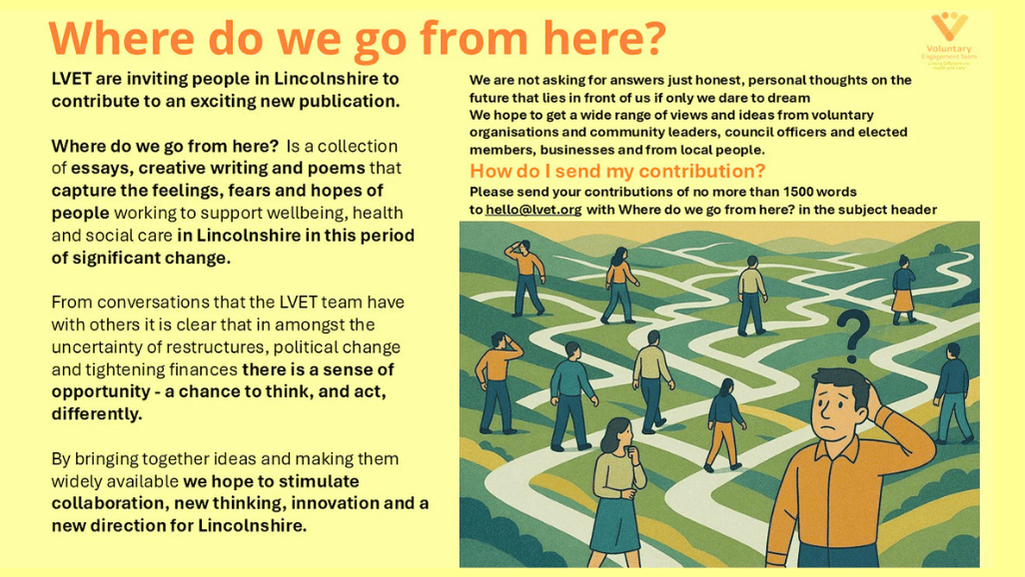

Where do we go from here?
A reflection - and plea - by Kirsteen Redmile, Lead for Personalisation, It’s All About People Personalisation Programme
“Well, what an 18 months it’s been across Lincolnshire’s health and care system.
A time of significant turmoil, upheaval, and upset for colleagues and friends. The ever-changing goal posts and expectations driven by the national agenda and the faceless people in their ivory towers.
You always expect change and opportunities, and in Lincolnshire we have thrived on that over the last few years, with strong relationships and partnerships developing, great collaboration and teams being prepared to try something new.
However, this time it feels different. With relationships being tested and people feeling frazzled, we revert to old ways of working, reaching out for our comfort blankets - and we start to bring back traditional ways of transacting, thinking, commissioning, and being.
We need to take time to pause and reflect to really understand if this ‘new pathway, process, policy, or procedure’ we’re putting in place is really going to make a difference to the people we support - or will it just make things even more difficult to navigate and access.
When do we say "That’s enough!" and press the simplify button? And when do we truly start to listen and act on what people are telling us, both Lincolnshire residents and our health and care workforce?
My plea is that we take the opportunity around Neighbourhood Health and Wellbeing seriously, with relationships and people at the heart of everything we do.
We know instinctively that if we have good relationships with people - if we’re kind, if we know who to connect with, if we’re prepared to make mistakes, learn and move on, if we work with and not for people - outcomes improve, our productivity and efficiency is better, and morale improves. Because people feel valued, trusted, heard, and respected.
And the evidence base is there; more and more research is telling us that if you want to transform services, relational management has to be at the heart and drive the change.
In Lincolnshire, we have Our Shared Agreement, a clear ambition to build stronger, more meaningful relationships between people, communities, and those who provide care. But ambition alone is not enough.
The real question is whether we are prepared to live it, breathe it, and make decisions that truly reflect it.
This is our moment to prove that “it’s all about people” is more than a phrase - it’s a promise. A promise to listen differently, to act differently, and to lead differently.
So, let’s stop circling the idea of change and start delivering it - together, with courage, honesty, and intent. Because if we don’t turn words into action now, we risk becoming part of the very problem we’re trying to solve.
Reflections on a reflection
A system at a crossroads
Kirsteen’s reflection speaks directly to the tension at the heart of LVET’s question. It captures a system that has not just been changing, but straining - where reform risks becoming disorientation, and ambition risks being lost in execution.
What stands out is the emotional truth: This period feels different.
Not because change is new, but because the way change is being experienced is testing the very relationships that transformation depends on.
The drift back to the familiar
One of the most important insights Kirsteen makes is the tendency to revert under pressure.
When systems are overwhelmed, they reach for:
- Structure over flexibility
- Process over people
- Control over collaboration
This is understandable, but it’s also dangerous, because it quietly undoes years of progress in partnership working and person-centred care.
Kirsteen challenges this drift head-on, asking whether we are unintentionally rebuilding the very barriers we once set out to dismantle.
The simplicity challenge
There’s a deceptively simple question running through Kirsteen’s plea:
Are we making things better, or just more complicated?
In a landscape filled with new pathways, policies, and procedures, the risk is that complexity becomes the default. But complexity rarely serves the people who need care, or the workforce delivering it.
The call to “press the simplify button” is not about doing less. It’s about doing what matters, better.
Relationship-based practice as the engine of change
If there is a single thread that sums up Kirsteen’s reflection, it’s the key importance of relationships.
Relationships not as an abstract value, but as a practical, evidence-based driver of:
- Better outcomes
- Greater efficiency
- Improved morale
This aligns powerfully with LVET’s broader narrative: that transformation is not primarily structural - it’s relational.
Kirsteen’s reflection reminds us that:
- Kindness is not optional
- Trust is not incidental
- Listening is not a formality
They are the work.
Neighbourhood Health: Opportunity or missed moment?
Kirsteen's reference to Neighbourhood Health and Wellbeing is particularly timely. Across the sector, this agenda is being positioned as a cornerstone of future reform.
But this reflection raises a critical challenge:
Will neighbourhood models genuinely empower relationships and communities,
or will they become another layer of system architecture?
The answer depends on whether we are willing to shift not just where care happens, but how it is conceived and delivered.
From agreement to action
Our Shared Agreement signals a clear ambition: to build better relationships between people and health and care providers in Lincolnshire.
But ambition alone is not enough.
Kirsteen’s reflection asks, with quiet urgency:
Have we truly embraced Our Shared Agreement? Are we committed to building better relationships?
The real test is not what we say we're going to do - it's actually doing it. And it’s what people experience as a result.
Call to action: Choose a relationships-driven future
LVET’s call for reflections is, ultimately, a call for direction.
Kirsteen offers a clear one. If we are serious about where we go next, we must:
- Re-centre relationships as the foundation of transformation
- Create space to pause and reflect before adding more complexity
- Listen - and act - on what people are telling us
- Empower neighbourhoods as relational ecosystems, not just delivery units
- Hold ourselves accountable to lived experience, not system intent
Because the path forward is not hidden.
We know what works. We know what matters.
The question is whether we are ready to commit to it, fully, consistently, and together.


