How Apex PCN reimagined support for frequent GP attenders
Primary care is often described as the “front door” of the NHS, but for some people, it becomes the only door.
Apex Primary Care Network (PCN) in Lincoln noticed that a group of patients were coming through that door again and again, often without getting the help they truly needed. Instead of accepting this as inevitable, the team decided to reimagine its approach.
What followed is a story not just of reduced appointments and system pressures, but of renewed confidence, restored connection, and the power of genuinely personalised support.

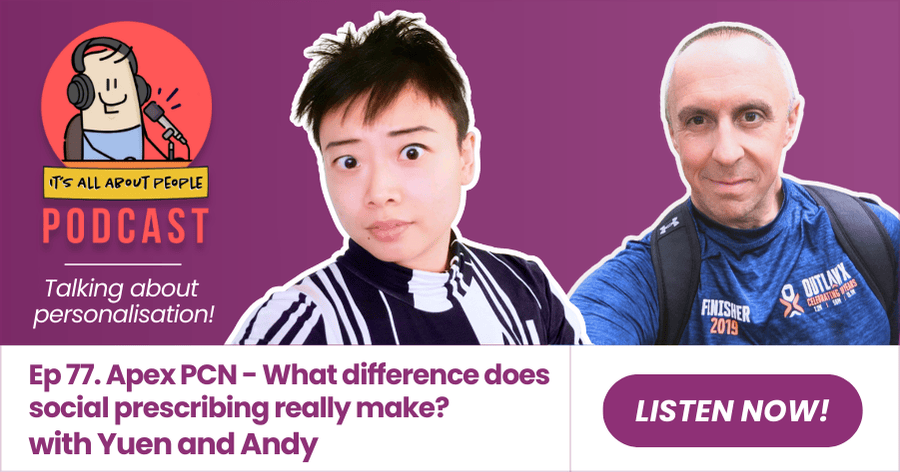
CLICK ON THE IMAGE BELOW to listen to Caty's conversation with Yuen and Andy from Apex PCN
Recognising when traditional care isn’t enough
Apex PCN started with an honest observation: some people weren’t getting what they needed from the usual GP model.
In our conversation with Clinical Director Yuen Toh, she explained that although these individuals were often labelled “high-frequency users,” the phrase hides a more important truth: they weren’t being served effectively by standard medical care.
Yuen: “In reality what it means is the traditional model… is not sufficient.”
The team recognised that these repeat visits weren’t driven by trivial concerns; they were often rooted in loneliness, anxiety, life challenges, or unmet social needs. So, the question became: What would it look like to actually meet those needs?
Building a different, more personalised model of support
Apex PCN’s answer was to take a proactive, personalised approach that combined data insight with human connection.
After identifying patients who were attending very frequently - but not due to unavoidable medical reasons - they connected them with Social Prescribing Link Workers (SPLWs) and neighbourhood teams who could genuinely take time to understand them.
Yuen described their method as blending population-level insight with deeply individual support:
“A real combination between the statistics… informing, then, a very, very tailored, personalised approach with an individual person.”
Rather than waiting for people to call or turn up, the PCN reached out first. And instead of assuming what patients needed, they asked, listened, and shaped support around the person, not the other way around.
Why Personalised Care works: People want to be heard
Senior Social Prescribing Link Worker Andy Garner highlighted something profound: many patients were returning again and again because the GP practice had become their refuge.
“Sometimes people see… the surgeries as their safe place. That is their place to turn to.”
For some, the receptionist was their one regular human interaction. For others, the doctor’s waiting room was a refuge from isolation. Without addressing these social and emotional drivers, no amount of clinical intervention could change their pattern of attendance.
Andy’s role wasn’t to replace medical care, but to widen the circle of support. He focused on listening - really listening - and helping people articulate what mattered to them. This shift in approach unlocked remarkable changes.
Human impact: When support matches what people care about
One story shared in Caty's conversation with Yuen and Andy illustrates the impact vividly.
A young woman had been attending the GP regularly, not because of escalating illness, but because it was the only place she saw other people. She used a mobility scooter, lived with anxiety, and felt she had nowhere else to go.
Andy met her where she felt safe - literally in the GP practice - then gently expanded her world by accompanying her across the road to the local library.
What happened next was remarkable.
She rediscovered a love for being outdoors, started volunteering in a community gardening project, and became an invaluable part of the team. As Andy recalls:
“She was just able to feel things in herself that I don't think she'd felt in years… she had somewhere else to go.”
Her attendance at the surgery dropped not because anyone pushed her away, but because she no longer needed it as her main source of connection and purpose.
This is personalised care in action: support designed around someone's strengths, interests, and hopes, not just their symptoms.
Collaboration and trust: The foundation for change
A key message from the project is that personalisation doesn’t happen in isolation. It requires better relationships - between clinicians, prescribers, neighbourhood teams, and the wider voluntary sector.
Yuen emphasised that this groundwork was essential:
“The relationship bit is really important… if we don't build that trust, it’s going to be really hard for us to… think about something new together.”
Andy echoed this, describing how being physically present built familiarity and confidence across teams:
“Everyone knows me. Reception staff say, ‘Oh, what are you doing here again?’”
Because Social Prescribing Link Workers were visible, welcomed, and understood, clinicians were more likely to refer, ask for input, and collaborate. This fostered a shared mindset:
Personalised care isn’t someone’s add-on job. Personalisation is everyone’s business.
The results: Human stories and system-wide impact
While the individual stories are moving, the data is just as powerful. Apex PCN saw:
- A 50% reduction in general practice appointments
- A 45% reduction in secondary care usage, including A&E, 111 and 999 calls.
Yuen admitted they had not expected outcomes on this scale:
“We thought, yes, it would improve slightly, but we did not expect such a huge number.”
And crucially, the data showed that a significant proportion of the supported patients were from the most deprived communities, meaning the project also became a powerful piece of health inequality work.
Lessons for the future: What makes personalised care work?
Asked what Apex PCN had learned, Yuen highlighted the importance of:
- 1. Strong relationships and open doors
- So that support workers can integrate naturally into practice life.
- 2. Clear communication and shared purpose
- Ensuring everyone understands why a new approach is being tried.
- 3. Closing the loop by sharing outcomes
- To show teams that their efforts make a difference, motivating future innovation.
Andy added that personalised care only works when people commit to showing up - literally - in the spaces where patients and colleagues are. His advice was simple but powerful: keep building trust, one cup of tea at a time.
Conclusion: Personalised care isn’t an add-on - It’s the work!
The Apex PCN project shows what can happen when health services dare to step outside routine and see people as people, not problems to be solved. When a patient feels heard, valued, and supported beyond their clinical needs, everything changes - their confidence, their wellbeing, their relationship with health services, and even their contribution to their community.
Personalised care is often described in policy language, but this project reminds us what it looks like in real life: a conversation in a library, a volunteer role in a park, a moment of human connection that ripples outward.
As the team at Apex has shown, when you build support around the person rather than the process, you don’t just reduce appointments, you help people rebuild their lives.

Our Shared Agreement Foundations in Action
Foundation 1: Being prepared to do things differently
The Apex PCN team recognised that frequent GP attendances weren’t solved through traditional clinical care and instead designed proactive, personalised support tailored to individuals’ real-life needs.
Foundation 2: Understanding what matters to ourselves and each other and Foundation 4: Conversations with and not about people
Apex practitioners took time to listen deeply to what individuals were seeking - such as connection and purpose - and shaped support around people’s strengths, hopes, and social needs rather than just medical symptoms.
Foundation 3: Working together for the wellbeing of everyone and Foundation 5: Making the most of what we have available to us
Collaborative relationships between clinicians, social prescribing link workers, neighbourhood teams, and voluntary organisations built trust, integrated resources, and improved wellbeing across the community.


