Lincoln City Foundation: People focused, community focused
The work of Lincoln City Foundation may begin at a football stadium, but as Alison's conversation with Alice Carter, Head of Healthier Communities and Phillip Watson, Health and Wellbeing Leader, reveals, its impact stretches far beyond the pitch.
Rooted in community, fuelled by compassion, and shaped by the people it serves, the Foundation is modelling what truly personalised, human-centred care looks like in action.

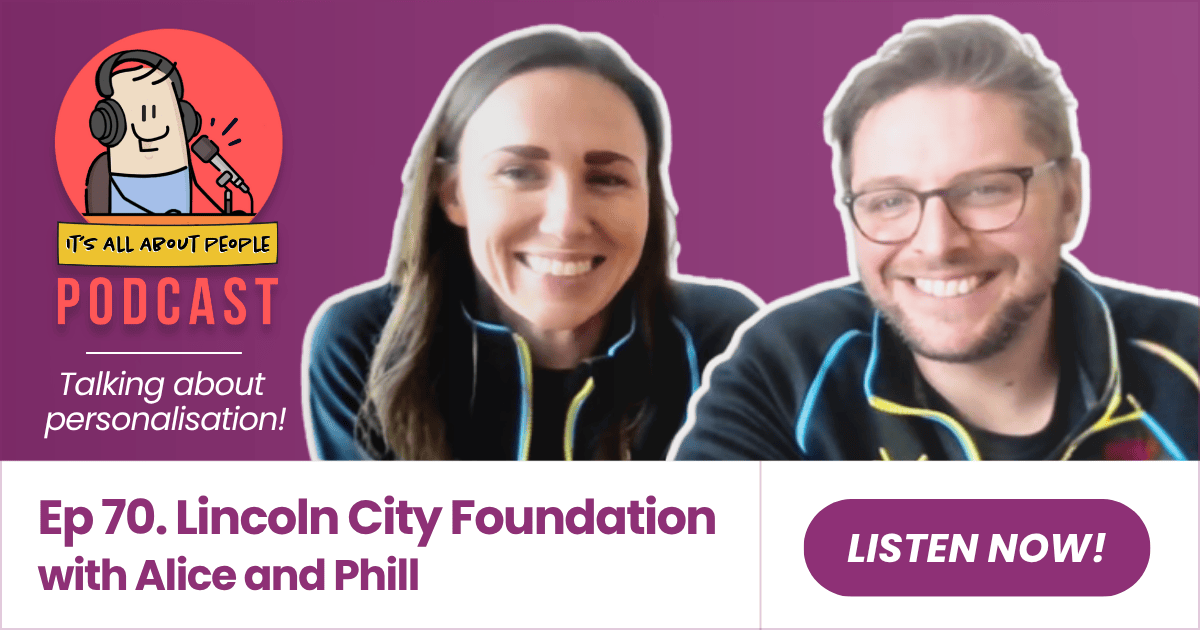
CLICK ON THE IMAGE BELOW to listen to Alison's conversation with Alice and Phill
More than football: A community-driven approach
Although the Foundation is the charitable arm of Lincoln City Football Club, its mission extends far beyond sport. As Alice explains,
“We are more than just football… We use Lincoln City’s reach, its connection to communities, the connection people have to the club itself, to really impact people across a variety of ways: mental well-being, physical health, social connection.”
Their work spans from early years programmes for toddlers to exercise groups in care homes for elderly residents. This wide remit reflects their belief that community support should be flexible, varied, and accessible to everyone.
What makes their approach particularly powerful is the emphasis on listening first. For Alice, shaping their offer is not about sitting at a desk deciding what people need. Instead, “It’s about actually what do the people out there want to do and how can we help them do it?”
This mindset sits at the heart of personalised care.
Listening as the foundation of change
The Foundation’s seven-year involvement in a major place-based social action project is a testament to the power of deep, meaningful listening.
Teams spent their first year simply meeting residents, “knocking on doors” and holding “pop-up listening sessions”. They learned about people’s concerns, aspirations, and crucially, the strengths already present in the community.
This approach led to practical changes, such as transforming unused spaces into green areas and developing resident-led campaigns. But perhaps the most impactful outcome was tackling social isolation, particularly for residents who lacked confidence or shared language.
Alice highlighted one example:
“One of the first things we identified was that people didn’t have the confidence to communicate… So, we started offering free English classes.”
These classes have improved communication and confidence, but their ripple effects go much further. Learners often go on to volunteer within Foundation projects, contributing to older adult groups and becoming an active part of the community. As Alice says, it helps people feel “not just someone who’s living in an area but not really part of it.”
This is personalised care in its truest form - supporting people not just to be in their communities, but to belong.
Fighting Fit: When support becomes a lifeline
If there is one programme that shows the transformative power of person-centred support, it’s Fighting Fit, the cancer rehabilitation initiative led by Phill and his team.
Designed for anyone living with or beyond cancer, the programme blends physical activity with something arguably even more important: connection.
Phill: “You can instantly change their mood, anxiety, maybe depression… You get them in a group environment, the exercise, the socialisation, the support they give each other—it just makes my job a lot easier, but I love it.”
Even outside formal sessions, the relationships continue. The group recently organised a fish and chip outing for 30 people. For Phill, watching them laugh, chat, and support one another was incredibly moving:
“I just thought, wow, this is something special.”
Over time, members have become friends who go to gigs, shop together, and rally around each other through treatment and recovery. Some of these friendships continue even after members pass away - proof of how deeply these bonds run.
Motivational Interviewing: The power of asking, not telling
Both Alice and Phill have completed Motivational Interviewing training through the “It’s All About People” programme, and both describe its profound impact on their practice.
For Phill, it provided a way to navigate difficult conversations with compassion and effectiveness:
“Straightaway I was like…these are the questions, this is the way I can help people… I noticed a massive difference in me understanding them a lot more.”
He describes supporting a socially isolated man to gradually build the confidence to become an active contributor to the group:
“Just by some of the questions… that helped him come up with his own answers.”
For Alice, the course reinforced the importance of deep, active listening - and the value of silence:
“It’s actually knowing that it’s okay just to let them talk… to not be thinking ‘I need to jump in’.”
This ability to listen deeply, without rushing to solutions, is central to personalised care, and central to the Foundation’s culture.
Relationships first: Why time and trust matter
One of the most powerful themes from the conversation is the value of time - time to talk, time to listen, time to build relationships.
Many services are pressured to deliver quick interventions, but the Foundation takes a different approach. Alice:
“It’s not just about turning up at one o’clock to do a session… It’s the time around that to build rapport, to really spend time building trust.”
This time investment allows for the personalised approach that underpins every programme they run. It gives space for stories, emotions, hesitations, and hopes - space for people to be people.
Moments that stay with you: Pride, loss, and community
When asked what they’re most proud of, both Alice and Phil return to the night their team won the Active Lincolnshire 'Impact on Health' Award.
For Phill, the memory is bittersweet - some of the participants who shared that night are no longer with them. But that only deepens the meaning:
“If we can improve their quality of life… help them enjoy life as much as possible - that’s why I love what I do.”
Alice recalls the tension of waiting for their category to be announced:
“My heart was racing… if they didn’t say our name, I’d have been gutted for them.”
The moment their group erupted in cheers is one she’ll never forget.
These reflections show that personalised care isn’t just a philosophy - it’s built on real relationships, real emotions, and real human connection.
Conclusion: Personalised care starts with people
Across every story shared, one message is crystal clear: personalised care doesn’t begin with services. It begins with people.
It begins with knocking on doors and asking, “What matters to you?”
It begins with giving people space to speak, to think, and to belong.
It begins with programmes like Fighting Fit that recognise that health is physical, emotional, and social.
And it thrives in organisations like Lincoln City Foundation, where listening is as important as doing.
As Alison’s conversation with Alice and Phill shows, personalised care is not a framework, it’s a way of being.
And at Lincoln City Foundation, it’s changing lives every day.


