Lincolnshire Wellbeing and Recovery College: Personalised care at the heart of mental health support
In January 2025, we sat down for a chat with Luke Sanby, Peer Trainer at Lincolnshire Partnership NHS Foundation Trust (LPFT), to hear the inspiring story behind Lincolnshire Wellbeing and Recovery College.
When Luke first walked through the doors of the Wellbeing and Recovery College, he wasn’t looking for a new career or a structured programme. He was searching for space - space to understand his identity after 20 years of caring for his mum, space to manage his own mental health, and space simply to be something other than “Luke the carer.”
What he found was something much bigger: a community built on equality, lived experience and practical tools for wellbeing. Today, he works within that same college as a peer trainer, helping others rediscover hope, confidence and control.
The College model is a powerful example of personalised care in action. Listening to Luke talk about it reveals a simple truth: when people’s stories are valued as much as their symptoms, transformative things can happen.

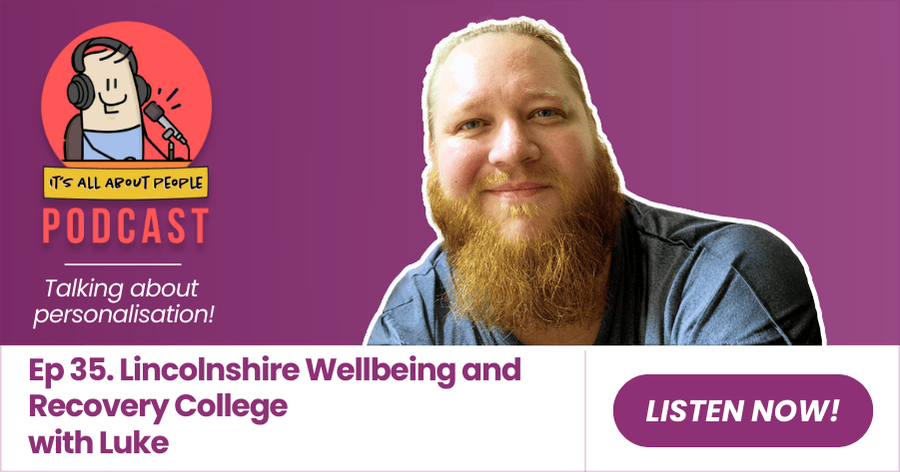
CLICK ON THE IMAGE BELOW to listen to our conversation with Luke

“We’re equals in this”: A new kind of learning environment
One of the most striking aspects of the Wellbeing and Recovery College is its approach to teaching. There are no teachers standing at the front delivering instructions. Instead, there are peer trainers, like Luke, who guide sessions alongside professionals in a collaborative environment.
Luke: “It’s sort of a flattening… there’s not a teacher–student relationship. We’re equals in this. We’re working together to learn.”
This approach is not only refreshing, it’s transformative. It positions lived experience as knowledge, not as a deficit to be fixed. Students learn not just from mental health practitioners, but from people who have been where they are, felt what they’re feeling, and found ways forward.
For Luke, that partnership of perspectives - clinical and experiential - is the magic of the model: “People who treated OCD (Obsessive-compulsive disorder) for 40 years know the process… but people who’ve had OCD for 40 years know the tips and tricks that really help.”
This blending of expertise creates an environment where recovery feels relatable, achievable and rooted in real life.
Personal journeys and the foundations of care
Luke’s personal story is central to his role, and central to the ethos of the Wellbeing and Recovery College.
For two decades, Luke cared for his mum, supporting her through mental health challenges of her own. After she died, he found himself lost:
“Your entire identity is wrapped up in that role… and then suddenly you don’t need to care for mum anymore. Now what?”
A work coach at the Job Centre recommended the Recovery College, and Luke joined a course called Bouncing Back. At first, he wasn’t sure what to expect, but the experience changed everything: “It literally changed my life.”
Rather than being sent down a formal clinical pathway, Luke found a space where he could explore his feelings, learn practical tools, and build a new sense of self.
What makes his story so compelling is that the very experiences he once feared were holding him back are now helping others move forward.
As Luke’s uncle put it: “Without that experience… you wouldn’t be able to do this. It’s your mum’s legacy.”
In personalised care, every story matters. Luke’s reminds us that personal experience, when valued and supported, can become a powerful source of strength.
Accessible, local and human: Meeting people where they are
The Wellbeing and Recovery College is not a building with echoing corridors or lecture theatres. It’s a network of community spaces - rooms in village halls, venues in towns, and virtual classrooms accessible from anywhere.
“There isn’t a campus… it’s based in places we already go,” Luke explained. “Village halls, community spaces… we try to get to all the places we can.”
This hyper-local approach is essential in a rural county like Lincolnshire. It removes barriers to access and helps people feel more comfortable learning in familiar, everyday places.
The courses themselves are flexible too:
- Some run for 90 minutes online
- Some take place in two-hour face-to-face sessions
- Others unfold over three weeks or longer
Whether someone is an unpaid carer in a remote village, a new parent needing emotional support, or a person managing anxiety, depression or OCD, the college brings learning to them in a way that fits their life.
This is personalised care at its most practical: meeting people where they are, not where the system expects them to be.
A curriculum rooted in real life
If you imagine textbooks and chalkboards, think again. The Recovery College curriculum is varied, creative, and grounded in everyday challenges people actually face.
Courses range from:
- Let’s Talk About Mental Health
- Understanding Anxiety, Depression or Bipolar Disorder
- Carer Burnout and Carer Awareness
- Food and Mood (co-delivered with a dietitian)
- Employment Confidence and Interview Skills
- Creative courses exploring wellbeing through art
- Perinatal courses for parents and partners
- Specialised programmes like Living with Perfectionism or Nurturing Confidence
Every course is co-produced, meaning students, peer trainers and clinicians design them together.
Luke describes this continuous cycle of improvement with pride:
“If a course isn’t working, we take it right back and do the co-production again… start from scratch, overhaul it.”
Rather than delivering a rigid set of materials, the college reshapes its offer based on what people say they need. Feedback isn’t a formality, it’s the blueprint for change.
Tools for everyday wellbeing: Small techniques with big impact
The courses aren’t just conceptual. They offer practical tools designed to help people navigate real moments of difficulty.
One example Luke shared is the technique of unhooking, a way to create distance from intrusive or negative thoughts. For someone with OCD, this can be life-changing.
Instead of saying, “I’m useless,” the technique encourages people to rephrase:
“I am having the thought that I am useless.” Then, “I notice that I am having the thought that I am useless.”
This subtle shift helps create emotional space and clarity. Luke found journaling especially helpful, writing the thought down, coming back later, and seeing it differently.
“It just helps you remove yourself… and look at it and think, ‘what a ridiculous thing.’”
These are the kinds of practical, personalised insights that empower people to manage their wellbeing day to day.
Hope, opportunity and control: The principles behind personalisation
The Wellbeing and Recovery College is built on three core principles:
- Hope – that learning and connection can support recovery
- Opportunity – to explore what helps you live well
- Control – over what you learn, how you learn, and whether you join in at all
Luke explained it simply but powerfully:
“You don’t get told what you have to do… control is choosing what courses you want, and even choosing to fill out the form in the first place.”
It’s an approach that trusts people to shape their own journey, and provides support rather than prescription.
Conclusion: Personalised care as partnership, not prescription
Listening to Luke, one thing became clear: personalised care is not a programme or a policy. It is a way of treating people as equal partners in their own wellbeing.
The Wellbeing and Recovery College does this by:
- valuing lived experience
- flattening hierarchies
- offering choice and flexibility
- embedding community at the centre
- and constantly adapting based on feedback
It’s not therapy. It’s not clinical care. It’s something more human: learning together, sharing power, and building confidence to live well.
Luke’s journey - from carer to student to peer trainer - shows the ripple effect of personalised support. What he once feared was a limitation has become a source of strength for others.
Luke: “This is what I’ve been looking for… this is what I’ve needed.”
And thanks to the Wellbeing and Recovery College, many others now have the chance to say the same.


