More than medicine: Care that fits real lives
Across health and care services, there is growing recognition that medical treatment alone is rarely enough. People’s lives are complex, shaped by relationships, circumstances, confidence, loss, identity, and hope. In the Living Well team at South Lincoln Healthcare Primary Care Network (PCN), this understanding is not just a principle, it’s the foundation of everyday practice.
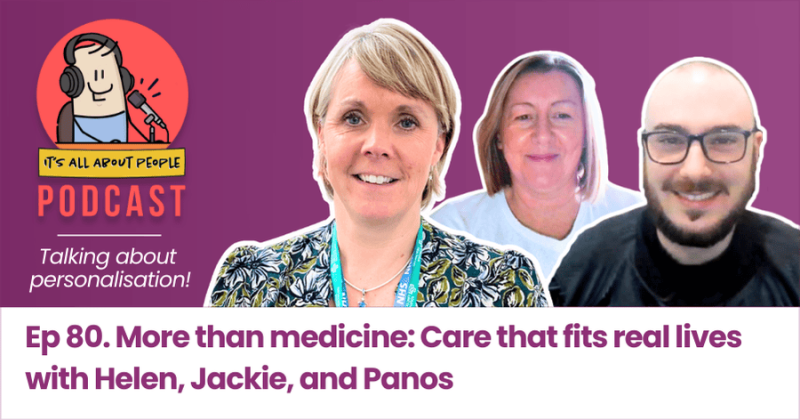
In December 2025, Alison from the It's All About People team sat down for a chat with South Lincoln Healthcare PCN Care Coordinators Jackie and Helen, and Health and Wellbeing Coach Panos, to explore how personalised, non-clinical approaches are transforming the way people experience care.
Their stories reveal what happens when services slow down, listen carefully, and shape support around what truly matters to each individual.
As Helen puts it, their work is about “taking away the medical side of things and just asking how they are.”
That shift, from condition-focused to person-centred, is making all the difference.

CLICK ON THE IMAGE BELOW to listen to Alison's conversation with Helen, Jackie, and Panos
One story, told once: The power of care coordination
Care coordination is still a relatively new role, but its impact is already clear.
Jackie describes it as “a proactive, not a reactive service,” designed to ensure “the right person at the right time.” Instead of patients repeating their story to multiple professionals, Care Coordinators help create continuity.
Jackie: “It ensures that you only have one story to tell, and you’ve got the access to the right service to meet the patient’s needs.”
At the heart of this approach is the idea that people are experts in their own lives. Care Coordinators don’t simply arrange appointments; they help connect the dots between health services, families, and community support.
Helen describes their work as “a holistic approach where we can have that welfare call, that chat, and get to the root of a problem.”
This coordinated way of working also reduces pressure elsewhere in the system. GPs, often limited to very short appointments, can refer patients knowing that someone else will take the time to listen, explore wider issues, and follow things through.
“What matters to me”: Personalisation in practice
One phrase comes up again and again in the conversation: "What matters to me". The care coordination conversations underpin care plans used by the Living Well team and are central to their philosophy.
Jackie describes care plans as “a ‘what matters to me’, holistic approach conversation,” capturing not just medical needs but “what’s important to them, their abilities, their independence, and their support network.”
These plans are shared across services so that professionals understand the "person behind the patient".
Crucially, this isn’t a tick-box exercise. Helen explains that asking what matters often reveals unexpected concerns. “It can bring up quite a lot of problems…things that wouldn’t come out in a medical appointment.”
One example came from Jackie’s cancer care work. She arrived expecting to talk about a cancer diagnosis, only to hear the patient say:
“Actually, I’m not worried about that. I’m worried about my Parkinson’s disease.”
That conversation opened the door to long-overdue specialist support and future planning.
Jackie: “The moral of the story is that what we think matters isn’t always what matters to the patient.”
Supporting change, not prescribing solutions
Health and wellbeing coaching adds another layer of personalisation. Panos describes his role as being about behaviour change, mindset and confidence, helping people to “create healthier habits and make lifestyle changes that are meaningful and important to them.”
Rather than telling people what to do, health coaching focuses on collaboration.
Panos: “We help people identify what they want to improve in their lives…and set goals that are specific, achievable and realistic for them, and recognise what may be holding them back.”
This approach respects autonomy and builds long-term resilience.
Panos: “The aim is to support people in taking ownership of their health and building a life where they feel healthier and happier.”
Like care coordination, health coaching is non-clinical, but deeply connected to clinical outcomes.
Improved confidence, better routines and stronger social connections all feed back into physical health and reduced reliance on acute services.
Care beyond the clinic: Meeting people where they are
Another strong theme that came through in this podcast conversation is the importance of reaching people in familiar, welcoming spaces.
Jackie describes how the Living Well team helped organise a Live Well, Age Well event at a local village community centre.
Instead of asking people to come into GP surgeries, services went out into the community.
Jackie: “It opened our teams out to the wider community…to put a name to a face.”
The event brought together 26 services, including Occupational Therapists, Social Prescribers, Pharmacists, mental health services, and even Lincolnshire Fire and Rescue. Mornings were open to the public, while afternoons focused on GP practice staff.
Helen highlights why this kind of event matters: “People need to know what’s available, but our colleagues need to know too. If we don’t know what’s available, how can we best support somebody?”
For many attendees, the event was an eye-opener. Some came with specific questions; others were “surprised to see the amount of services that are available to them.” Awareness, in itself, became a form of empowerment.
Frailty, hospital admissions and early intervention
Much of the Living Well team’s day-to-day work focuses on people at higher risk, particularly older adults. Helen describes how Care Coordinators track unplanned hospital admissions for people over 65 and follow up with welfare calls shortly after discharge:
“It’s just to make sure that everything is OK when they get home.”
But those calls often uncover unmet needs, leading to referrals for occupational therapy, medication reviews, wellbeing support, or community services.
Frailty work is another key area.
Helen: “We’re providing early intervention to prevent progression of frailty or hospital admission.” The aim is to help people stay active, independent, and well at home for as long as possible.
This preventative focus shows how personalised care can reduce crisis-driven responses. By understanding someone’s circumstances early, support can be put in place before problems escalate.
Co-production: Learning and shaping services with people
Personalisation doesn’t stop at individual care - it also shapes how services are designed. Helen and Jackie describe working with local residents to co-produce letters, care plans, and information materials.
Helen: “It was a bit of an eye opener. They were very critical of our letters, but it worked well in the end.”
The co-production group helped simplify language, improve clarity, and ensure materials worked for people with lower levels of literacy.
Helen: “We learned from each other. The co-production is very, very positive.”
That openness reinforces trust and ensures services are shaped by real experiences, not assumptions.
Rose’s story: A whole-person approach to support
Perhaps the most powerful illustration of personalised care comes from Helen and Panos’ shared story about a woman navigating bereavement, learning disabilities, and isolation.
After losing her husband, Rose was struggling to live independently. Rather than assuming she couldn’t cope alone, the team focused on building trust and wrapping support around her.
Helen: “There was first of all a need to build that relationship and earn the trust.”
Support came from multiple directions: budgeting help, independence training, assistive technology, bereavement support, and health coaching.
Panos describes how coaching helped Rose reconnect with activities that brought her joy - walking, swimming, church, bingo, and knitting.
Panos: “Grief is another side of love, and it became about helping Rose to reconnect with the areas of her life that helped her feel happier and healthier.”
Over time, Rose grew in confidence and independence. When Helen later visited, she found Rose busy cleaning her home, something unimaginable at the start of the journey.
The outcome wasn’t just practical support, but dignity, choice, and a life Rose wanted to lead.
Conclusion: Want better outcomes? Work in a person-centred way
What stands out across all these stories is not a single intervention, but a consistent way of working: curiosity instead of assumption, collaboration instead of instruction, and humanity instead of haste.
Whether through care coordination, health coaching, community events, or co-production, the Living Well team shows what happens when services are built around people, not ‘pathways’.
As Jackie puts it, support often “starts as a little acorn and builds into a big tree.” That growth is only possible when care is personalised, shaped by what matters most to each individual.
In a system under constant pressure, these approaches remind us of something essential: when we truly listen, work together, and trust people to lead their own lives, better outcomes follow, for individuals, families, and the system as a whole.


