Personalisation in maternity care
Becoming a parent is a major life transition, and the care people receive during pregnancy, birth and afterwards shapes how confident, supported and informed they feel. But no two pregnancies are the same. Each person brings their own hopes, histories and concerns, and their maternity care should reflect that.
Across the UK, services are moving away from one-size-fits-all approaches towards care that truly listens and adapts. Personalisation in maternity care isn’t a luxury; it’s about respecting every individual’s needs, voice and choices.
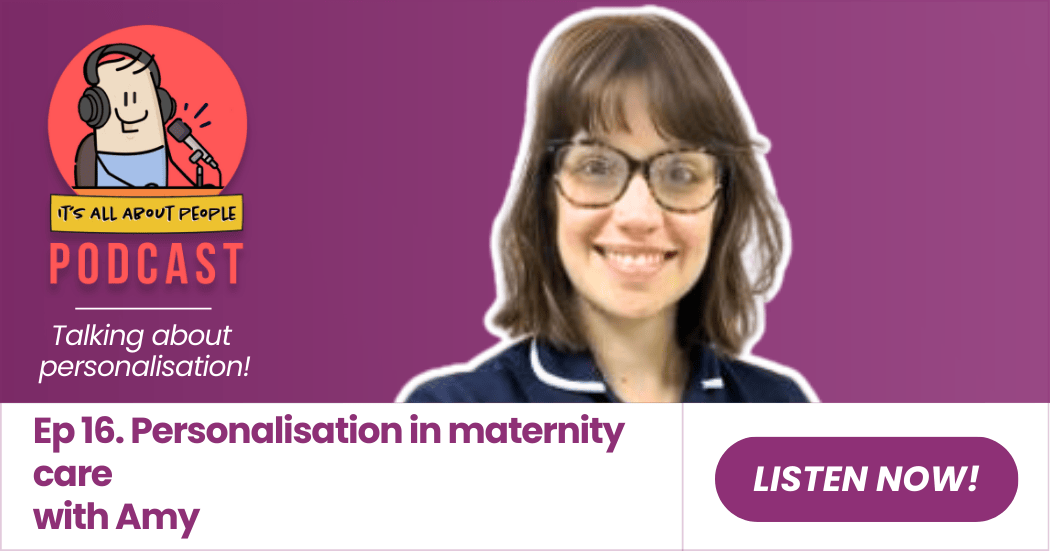
We had a great conversation with Amy Garratt, Specialist Midwife at United Lincolnshire Teaching Hospitals NHS Trust (ULTH). Amy made it clear that this shift is already underway in Lincolnshire, led by teams committed to delivering care that feels right, relevant and compassionate.

CLICK ON THE IMAGE BELOW to listen to our conversation with Amy
Personalisation at the heart of maternity care
Maternity care has long embraced a personalised ethos. As Amy explains, “personalised care, or as we used to call it in maternity, individualised care, is something that’s kind of our bread and butter.” Midwives routinely ask “what matters” to women and families, adapt to personal needs, and build trusting relationships over months, not minutes.
But the push for more consistent personalised care support planning, shared decision making, and digital access means maternity services are evolving again.
Training plays a key role. Amy delivers full-day Personalised Care and Support Planning (PCSP) courses with colleague Kat, and says the motivation from staff is energising:
“They get it, they want to do it… it reignites the passion for it.”
Seeing midwives share examples from practice reinforces how personalisation is not just policy. It’s meaningful, beneficial, and already part of the culture.
Bringing notes into the 21st Century with BadgerNet
One of the biggest shifts in maternity personalisation is the introduction of BadgerNet, a digital system that gives women real-time access to their maternity notes via an app. This represents a major move away from the old paper 'bounty pack' and brings women directly into the heart of their care.
Amy described the change with genuine excitement:
“Women will have access to an app… they’ll be able to see everything we input and respond to that.”
This means questions can be asked between appointments, information can be revisited as needed, and care becomes far more collaborative.
The shift is huge, not just technologically but culturally. It encourages transparency, reinforces shared decision making, and helps women feel informed and prepared.
And while it will take time - “a year to two years” for full rollout - the long-term gains are clear:
“It’s really exciting… it will transform the care and interaction we have with those coming through our care.”
Preparing and supporting the workforce
Change is never easy, and introducing new digital systems naturally creates apprehension among staff. Will workloads increase? Will there be a surge of messages through the app? Will people struggle with the technology?
Amy acknowledged these concerns, but she also explained why midwives are embracing the shift:
“This is the care we genuinely like to deliver… the ability to actually hear what women want to say.”
Midwives want to focus on people, not screens. They want to build relationships, support decision making, and deliver holistic care, yet current systems sometimes pull them away from that. BadgerNet has the potential to give back time, clarity, and human connection.
Ongoing training and phased implementation aim to build confidence across the workforce.
Importantly, personalisation is already deeply embedded, so midwives are well-placed to thrive in a more transparent and collaborative digital environment.
Supporting better shared decision making
Shared decision making is a central feature of personalised care, and maternity offers rich opportunities for meaningful, structured conversations about options, risk, birth plans, and preferences.
But, as Amy pointed out, appointments can be overwhelming:
“We talk at length… and then at the end say ‘have you got any questions?’ I mean, even if you had a long list, I don’t know that you’d remember to say them.”
BadgerNet helps with preparation, but the team is also using Ask Three Questions, a national resource that encourages people to ask:
- What are my options?
- What are the benefits and risks?
- What does this mean for me?
To support this, Amy’s team have redesigned the interim paper notes. They now include colour-printed Ask Three Questions guidance and space for women to write what matters to them.
This simple shift aims to build confidence early:
“It’s just dropping that seed of what’s to come… a really good starting point for having those conversations.”
Staff are benefiting too. Having visible “what matters” notes helps steer appointments towards meaningful personalised care.
Case example: Birth Choices Clinic and the CQUIN Project
One of the strongest examples of personalised care in action is the Birth Choices Clinic, run by consultant midwives. The clinic offers flexible appointments, often remote, at times that fit the woman and partner, and with no rush or appointment limits.
Amy described why people value it:
“It can be as long or as short as they need… and can be repeated… they get that extra level of care.”
As part of a national Commissioning for Quality and Innovation (CQUIN) requirement around shared decision making, the team collected data on women’s experiences using the Collaborate tool. The results were exceptional:
- 100% of women reported satisfaction with shared decision making
- Some quarters scored as high as 196% due to weighted scoring
- Women felt listened to, involved, and supported
Amy summarises the learning beautifully:
“We know that that group of women are getting…excellent shared decision making.”
The aim now is to spread that quality across the whole service, not by replicating the clinic for all, but by sharing the methods, culture, and communication approaches that make it work.
The power of relationships and ongoing engagement
One striking theme is the ongoing connection between maternity services and families, even years later. Surveys shared on social media get responses from people whose babies are now “five years old”. The willingness to stay engaged reflects the meaning and impact of personalised care.
Amy explained:
“Women don’t tend to just have their babies and then disappear… they want to be involved.”
This relationship-based model is something other pathways could learn from.
Continuity, trust, and emotional safety all support better outcomes.
Lessons for the wider system
Throughout our conversation with Amy, several lessons emerge that apply far beyond maternity:
Learn from each other
“We can all learn lots from each other.”
Cross-pathway collaboration enriches practice and spreads innovation.
Prepare the workforce
Personalisation succeeds when staff feel confident, motivated and supported.
Build enabling systems
Digital access, well-designed notes, and simple prompts (like Ask Three Questions) make personalised care easier and more consistent.
Keep people at the centre
Continuity, relational working and “conversations with, not about” (Our Shared Agreement Foundation 4) people must remain the foundation.
Conclusion: Personalised maternity care as a model for change
Amy's insights highlight a maternity service deeply committed to personalisation, and actively reshaping itself to strengthen that commitment through digital innovation, training, shared decision making, and patient-led care.
The developments in maternity show how personalised approaches:
- improve preparation
- build confidence
- strengthen shared decisions
- increase satisfaction
- deepen relationships
- support safer, more empowered experiences
In Amy’s words, personalised care is not an add-on - it is the work:
“This is the care we genuinely like to deliver… what matters most to those we care for.”


