Personalisation in Outpatients
Personalisation in Outpatients isn’t just a policy idea - it’s something real, practical and deeply human that’s already shaping the way clinicians and people work together every day.
In the Podcast conversation we had with Fran Keane, a Clinical Specialist Physiotherapist, we explored what it truly looks and feels like when outpatient services step outside traditional boundaries - when we listen closely to people’s lived experiences, and create care that genuinely reflects what matters to them.
From innovative community clinics to honest co-production and the small moments that build trust, this is a story about changing culture one conversation at a time.
Fran is a Clinical Specialist Physiotherapist with a focus on musculoskeletal (MSK) and orthopaedics at United Lincolnshire Teaching Hospitals NHS Trust (ULTH)

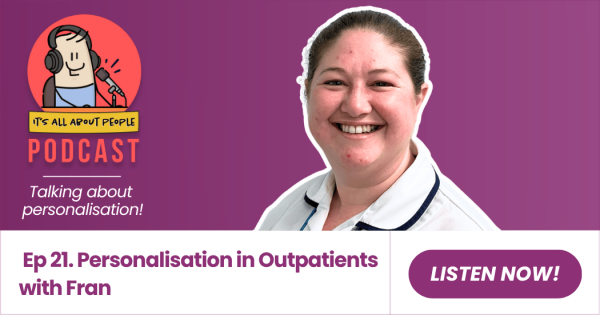
CLICK ON THE IMAGE BELOW to listen to our conversation with Fran
Working differently in Outpatients
Our conversation with Fran began with her reflecting on how outpatient teams are increasingly embracing personalisation.
Fran's role is varied - clinical work, staff support, improving patient care - and she describes therapies as naturally suited to person-centred working because time with patients is built into the model.
This idea of “working differently” was brought to life through the Grantham Joint Aches and Pains Hub event.
Fran remembered the initial shock when the proposal for the event was introduced: moving a clinic out of the hospital and into a sports hall. Initially, there were governance worries, privacy concerns and staff anxiety.
But once the event had been delivered, something unexpected happened....
Fran: “There was a feeling of… almost liberation for some of the staff… being able to come out of the usual environment and do something different.”
Being out of the traditional clinical space unlocked creativity and fresh thinking. Most importantly, all the services and community partners were in one room, which strengthened relationships and made signposting easier and more meaningful.
Fran: “We didn’t realise they existed… let’s make a contact over there because that’s going to help us and our patients.” (on networking at the Grantham Aches and Pains Hub)
Another real highlight of the event was the way the event created space for people with shared challenges to come together and support one another.
Fran: “There’s something in there about patient support for each other… people sharing stories and swapping tips.”
Co-production as a powerful connector
Fran’s first experience of co-production was both eye-opening and challenging. Listening directly to people with lived experience forced the clinical team to confront assumptions, especially around what people want, when they want it, and how they want information to be given.
Fran: “Often the barriers to engaging with patients is we don't really want to hear what they might say in case it's negative.”
“It was really interesting to sit and listen… picking up on things that haven’t been done well during their healthcare journey.”
“We’re probably presuming what patients want to hear… and actually that’s not the case.”
The group surfaced persistent themes linked to COVID-era care, inconsistent communication along pathways, and the emotional impact of delays.
From those conversations came practical changes, such as developing Frequently Asked Questions (FAQs) shaped by real patient concerns. Some of the questions were unexpected, the kind clinicians might overlook, but they mattered deeply to the people living the experience.
Co-production also clarified a gap between what clinicians think physiotherapy is, and what patients expect physiotherapy to be.
Many still assume physios will “fix” them hands-on…
Fran: “Some patients think they’re coming for a massage or maybe some acupuncture… they don’t necessarily always understand what physio is these days.”
Modern physiotherapy, however, is about guided self-management, empowerment and long-term health improvement.
Naming that mismatch is helping the team reset expectations earlier and more consistently.
Understanding what matters: Conversations, expectations, and roles
Good physiotherapy care starts with a good conversation. Fran highlights the essential elements: understanding the person’s history, the social and emotional impact of their condition, and, crucially, their goals.
But poor referrals often make this harder. Patients sometimes arrive without knowing why they’ve been sent, or expecting quick fixes that aren’t realistic.
Fran: “For some people, it is a real disappointment… they thought they were going to the consultant for that final fix.” (on being redirected to physiotherapy instead of surgery)
This is where shared responsibility comes in.
Fran describes a shift away from the old paternalistic model (“the clinician will sort it”) towards partnership working.
Tools like Patient Activation Measure (PAM) scores and shared decision-making resources help identify how ready someone is for self-management, and how much support they may need.
Some patients embrace this immediately; others find it challenging, especially if they expected surgery rather than physiotherapy.
Supporting people to “wait well” and remain in control of their health journey is now a central part of outpatient work.
Fran:
“We’re kind of the facilitator in their recovery rather than doing it to patients or making it happen for them.”
“A good conversation is about expectations of physio and the goals of the patient… what do they want to get back to doing?”
“We need to support this patient to get to where they need to be without doing it for them.”
“It’s giving them the control back… because accessing healthcare, they feel all their control has been taken away from them.”
Bringing the system together
Our conversation with Fran closed on a wider reflection: everyone - patients, staff and partners - wants a better, smoother, more personalised system. The challenge is keeping up with new tools, pathways and innovations.
Fran: “We haven’t got it flowing through the system yet… there are definitely things to iron out.”
Fran’s message to leaders is simple: stay curious.
Look at what works elsewhere, use platforms where everything is gathered in one place, and keep listening to people who use the service.
Fran: “Sometimes it's just being nosy… getting out there and going, I’m going to arrange to go around one of the CDCs (Community Diagnostic Centres) and have a look at what they’re doing differently.”
Personalisation isn’t a bolt-on, or a nice to have. Personalisation is a mindset, and one that physiotherapy is already well-placed to champion.


