Personalised cancer care in practice
Personalised cancer care is often discussed in policy papers, but what does it look like in real people’s lives?
We spoke to Lauren Gray, a Macmillan Senior Cancer Care Coordinator whose role bridges hospitals, community teams, and the often shaky ground patients stand on when treatment ends.
In our conversation, Lauren provided a clear picture of how personalised approaches are transforming patient experiences, smoothing transitions, and improving outcomes across the cancer pathway and the often shaky ground patients stand on when treatment ends.
Her experience shows how personalised care isn’t just a 'nice to have', but is instead a practical, deeply human approach that can steady patients at their most vulnerable moments. It helps ease the transition back into everyday life, and make sure no one feels left behind on their cancer journey.

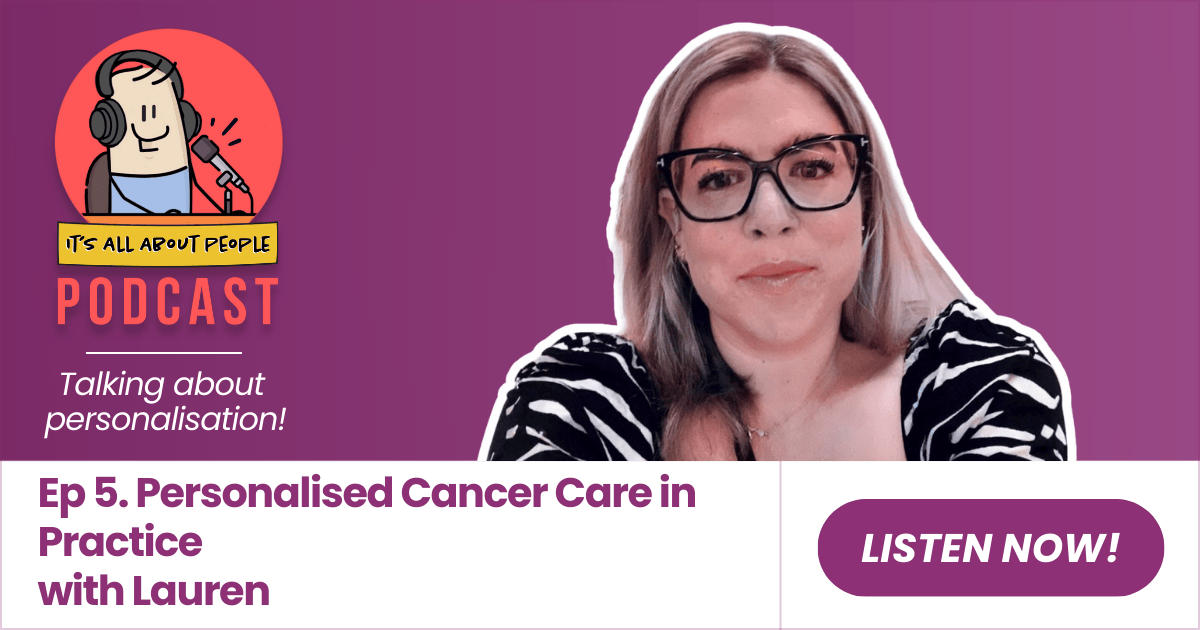
CLICK ON THE IMAGE BELOW to listen to our conversation with Lauren
A role built around personalisation
Lauren’s role is unusually positioned: she is Macmillan-funded but works within the Lincolnshire Integrated Care Board (ICB), acting as a bridge between acute hospital teams and community services. Her job exists because people finishing cancer treatment often feel a sudden drop in support, and this transition point desperately needs personalised attention.
As she explained, her team “fill those gaps and… support those patients to transition out safely” when they move from hospital-based treatment back into their community.
This focus on the whole person, not just their cancer type or treatment regime, is embedded from diagnosis through to follow-up and recovery.
Personalisation starts early: Understanding ‘what matters’ after diagnosis
Receiving a cancer diagnosis is overwhelming. Yet Lauren emphasises that this moment is precisely when personalised conversations matter most:
“It’s really important that we get that personalisation in early… to support them through that cancer pathway.”
One of the earliest tools used is the Holistic Needs Assessment (HNA), which must be offered within 31 days of diagnosis. But it’s not just a form to complete, it’s a gateway into what matters to the person.
Patients receive a checklist highlighting possible concerns, but Lauren stresses that clinicians “want it to be a conversation. They don’t want it to be a tick box.”
The assessment helps surface worries that may not be medical at all: “family… financial concern… practical concern”.
By identifying these early, staff can tailor support, plan ahead, and connect patients with the right services, from benefits advice to emotional support to work-related guidance.
Mapping a personalised End-of-Treatment journey
One of the most striking pieces of work Lauren described is the emerging End of Treatment Model, a visual, personalised pathway designed to ensure no patient feels abandoned once hospital treatment ends.
Many people on their cancer journey describe this moment as a “cliff edge”, moving from intense clinical contact to a sudden withdrawal of support.
Lauren:
“They’ve had that really intense support… and then all of a sudden they’re out trying to rebuild their lives.”
The model aims to replace that cliff edge with a guided bridge. Key personalised elements include:
- • End-of-Treatment Holistic Needs Assessment and personalised planning
This builds on earlier assessments but focuses on readiness for life after treatment.
- • Patient Activation Measure (PAM)
Used to understand a person’s knowledge, confidence and readiness to self-manage. This allows staff to tailor follow-up intensity.
- • A personalised decision about follow-up route
Each patient has a conversation about whether consultant-led or self-supported follow-up is appropriate. This depends on risk of recurrence, confidence, and preference.
- • Supported signposting to community services
Patients are guided towards programmes such as Fighting Fit, HOPE courses, therapy, and local wellbeing resources.
Lauren described it as “all about that preparation and all about safety-netting those patients… making them feel like we have got a little bit of string attached to them.”
This model illustrates exactly how personalisation can be structured without becoming rigid, maintaining a clear pathway while responding to individual needs.
Personalised Follow-Up Pathways: Empowerment through choice
The Personalised Follow-Up Pathway (PFUP) is another key component. Once treatment ends, patients are stratified as high or low risk. They then decide with the clinicians supporting them what type of follow-up they'd prefer or feel ready for.
Lauren:
“It’s the decision… is this patient high, low risk? What would their follow-up look like?”
Low-risk patients may take a remote monitoring route, which:
- reduces unnecessary hospital visits
- gives patients more control
- frees capacity for those who need face-to-face review
- provides rapid recall if concerning symptoms arise
Crucially, this route forward is not imposed. Patients need to feel capable and willing. “It needs to be appropriate for both the clinician and the patient… some patients might think that’s not for me.”
This shared decision-making avoids a one-size-fits-all approach and instead builds a personalised follow-up plan rooted in safety and empowerment.
Personalisation for everyone: Tackling barriers and inequalities
Personalisation means very little if people cannot access support because of language, transport, or digital barriers. Lauren highlighted how rurality, demographics, and diversity in Lincolnshire create specific challenges:
“There are lots of challenges… non-English speaking, no access to transport… carers…”
One powerful example of personalised problem-solving is the translation of Patient Activation Measure (PAM) materials. Realising that many patients in areas like Boston could not engage with the English-only leaflets, the team secured funding to translate materials into the most commonly spoken local languages.
“We recognised that we were excluding those people… so we secured funds to get the leaflet translated.”
This small change opens the door to personalised care for hundreds of patients who would otherwise be left behind.
Including carers in personalisation
Carers often shoulder a huge emotional and practical load, but their needs can be overlooked. Lauren is passionate about using the Patient Activation Measure (PAM) with carers:
“I love the Carers’ PAM… they’re really powerful questions… it’s about the carer, not the person they’re caring for.”
By identifying the carer’s readiness, stress levels, and support needs, staff can personalise support around the whole family unit, not just the patient. In cancer, where treatment and recovery affect everyone involved, this holistic approach is crucial.
A system-wide culture of personalisation
Throughout our conversation with Lauren, one theme was constant: staff already care deeply, but systems and structures need to evolve to fully embed personalised approaches.
Lauren acknowledged this tension:
“Staff feel like they are delivering personalisation… but new ways of working like Remote Monitoring Systems (RMS), PAMS, you know, is something new, it's something...they've got to kind of adapt to and bring into their work. And...they're already stretched, as we know, and that's something that we can't ignore."
This honesty demonstrates that personalisation is not simply a new tool or form - it’s a cultural shift requiring support, communication, and perseverance. But the benefits, for patients, staff, and the wider system, are clear.
Conclusion: Personalisation as the core, not the add-on
Lauren work demonstrates that personalised care is not an abstract ideal. It is a practical, structured approach that can be built and embedded into complex cancer pathways.
Through tools like HNAs, PAMs, PFUPs, remote monitoring, and translated materials, and through thoughtful mapping of the end-of-treatment experience, the cancer care team in Lincolnshire is showing how personalisation can:
- improve patient confidence
- reduce unnecessary appointments
- support independence
- address inequality
- ease the emotional shock of diagnosis and recovery
- help people rebuild their lives after treatment
Most importantly, it ensures that no one feels alone at the point where care transitions are at their most fragile.
“No patient should feel like they’re falling off the cliff… all we have to do is show them the way to go.”


