Time to talk: Personalisation in Talking Therapies
The Lincolnshire Talking Therapies service is built on the belief that mental health support is most effective when it honours the individuality of every person who walks through the door.
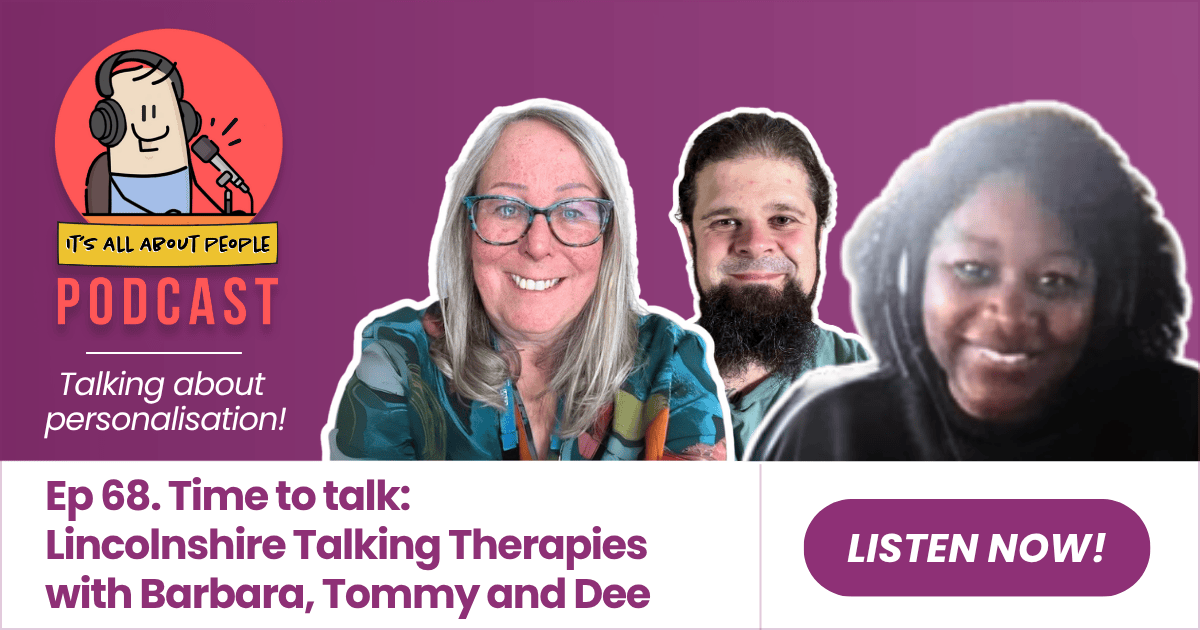
In a recent It’s All About People podcast episode, Caty sat down with Dee, Barbara, and Tommy from the service for an open and inspiring conversation about mental health and the power of talking.
Across their stories, a number of powerful themes emerged - collaboration, safety, honesty, co-production, and the life-changing impact of tailored therapeutic relationships.

CLICK ON THE IMAGE BELOW to listen to our conversation with Dee, Barbara, and Tommy.
Understanding the service: Accessible, practical, human
Barbara: “We are part of the NHS… primarily working with people with mild to moderate to severe mental health difficulties…anxiety, depression, obsessive compulsive disorder, panic, trauma, social anxiety.”
What stands out is not just what the service does, but how it does it. It is intentionally flexible:
- Face-to-face, telephone, or video sessions
- Group work, such as worry management or low-mood groups
- Computerised cognitive behavioural therapy (CBT)
- One-to-one sessions with Psychological Wellbeing Practitioners (PWPs), CBT therapists, counsellors, or interpersonal therapists
- Support for people with long-term physical conditions
- Employment advisors to help individuals stay in or return to work
Crucially, people can self-refer: “You don't need a GP appointment… If you google Lincolnshire Talking Therapies… you can do an online referral and we will be contacting you within the next day or two.”
This openness signals a commitment to make mental health support easy to reach, rather than something people must fight their way into.
Personalisation through collaboration
One of the most resonant threads throughout the conversation was the importance of collaboration in therapeutic work.
As Dee explained, at the heart of CBT is the principle that both therapist and client work as equals: “One of the biggest things that we really try to focus on is collaboration… the biggest takeaway we would hope anyone has is to become their own therapist.”
This means therapy is driven by client goals, not clinician agendas. It means listening deeply, adapting approaches, structuring sessions around real-life needs, and building skills that last long after sessions end.
Tommy’s story is a lived illustration of what collaboration looks like. He describes his therapist Caroline’s honesty from day one: “She just said… if you'd like to work with someone who's been doing it for longer, that's fine…” - and how that transparency built trust rather than doubt.
Her way of offering alternative perspectives wasn't imposing but supportive:
“She’d hear me out and then give me another perspective… very balanced, very reasoned and very fair.”
That balance - gently challenging someone while still recognising their feelings - is what makes personalisation real and meaningful.
Creating a safe and human space
Personalised care only works when people feel safe enough to show up as themselves. All three guests spoke about the importance of safety - not just clinical safety, but emotional safety.
Dee described this powerfully from the therapist’s perspective:
“You want to offer every client a safe space… There are two people in that room. It has to be safe for yourself and safe for the client as well.”
Her story about a client giving her a 3D-printed figure with brown skin, just like hers, shows how therapy becomes a two-way, human connection when both people feel fully seen.
“I felt totally seen,” she recalls. “It validated how he had felt as well… it wasn’t just one person in that room, it was two.”
Barbara echoed this theme, noting that the feeling of safety begins even before someone enters the therapy room:
“Our admin ladies… are rays of sunshine… You’re taking a leap of faith and making yourself vulnerable. You want to feel safe.”
Safety isn’t just an idea. It’s something everyone helps create together.
Therapy as transformation and self-discovery
Perhaps the most powerful insights came from Tommy, who generously shared his personal experience of therapy across multiple stages of life.
What emerged is a picture of therapy not as something “fixing” him, but something that helps him understand himself and move through life with more clarity.
He reflects on the value of reflection:
“The minute you stop talking and listening… that’s when you resign yourself to just stay where you are.”
He describes how Cognitive Behavioural Therapy helped him challenge catastrophising thoughts, notice patterns, and develop practical mental tools. One of these tools was imagining a “roadblock” stopping spiralling thoughts - visual, concrete, and grounded in his learning style.
The moment that stayed with him most was a simple analogy from his therapist about flying:
“A situation itself isn’t stressful — the interpretation is… Flying isn’t scary. It’s scary to some and not to others.”
For Tommy, this landed deeply: “Stuff’s only obvious when you know it, isn’t it?”
Therapy didn’t just teach him new skills; it taught him to see himself differently.
The importance of therapist vulnerability and reflection
Another striking element is the therapist’s journey, often invisible to those outside the profession.
Dee describes how being a therapist has reshaped both her personal and professional life:
“It’s changed me… It’s a vocation.”
A key component is supervision, a place where therapists confront their own thinking patterns, self-doubt, and emotional reactions.
“Very exposing… but it allows you to walk the walk that your clients walk.”
This honesty and humility enriches the personalised care therapists provide. Personalisation isn’t just for the client; it shapes how therapists grow too.
Co-production and listening to lived experience
Barbara emphasised the Voice2Change group, a co-production approach where people who have used the service help to shape it.
“The best way to know you’re doing your job properly is by the people who’ve used the service… We welcome constructive feedback.”
Tommy is joining this work and reflects on the value of contributing after therapy:
“It’s nice to be asked… it could hopefully reassure and help somebody else who’s looking at using the service.”
Personalised care is not just about tailoring therapy sessions. It’s about tailoring the service itself through the voices of people who know what works.
CLICK ON THE IMAGES IN THE SIDE PANEL to:
- Download the Lincolnshire Integrated Care System Co-production Framework: Building our Co-production Community Together
- Find out how to become a Co-production Champion
Conclusion: Personalised care is people care
Across every story and perspective, one truth shines through: personalised care is fundamentally about people caring for people.
- It’s the therapist who adapts their approach to how someone learns.
- It’s the client who brings courage, humour, and honesty to the room.
- It’s the admin team creating a warm welcome.
- It’s the service listening to lived experience to shape its future.
Barbara: “We don’t come to work to do a bad job… Sometimes it doesn’t land the way we intend, and we need to be open and honest and address that.”
That openness - to feedback, to learning, to building relationships and trust - is exactly what makes Lincolnshire’s Talking Therapies a powerful example of personalised mental health care in action.
Ultimately, personalised therapy isn’t about delivering a service. It’s about creating a space where people feel seen, safe, and supported. And where they can, in Tommy’s words, “learn to think for themselves” with confidence long after the sessions end.


