Project Compass
For Episode 64 of the It's All About People Podcast, Caty sat down with Becky Frost, Project Manager, and CJ Jago, Deputy Project Manager, from Project Compass in Lincoln to talk about their inspiring, person-first approach to supporting people who are sleeping rough.
For Becky, CJ, and the Project Compass team, it all begins with something simple but essential:
Creating a space where people feel safe, welcome, and never judged. Somewhere you can come in, sit down, have a cuppa, and get support with basic needs.
This “open door” approach doesn’t just change lives at Project Compass - it’s also influencing other services. Because when you meet people where they are, at the moment that feels right for them, that’s when real change starts to happen.

CLICK ON THE IMAGE BELOW to listen to Caty's conversation with Becky and CJ
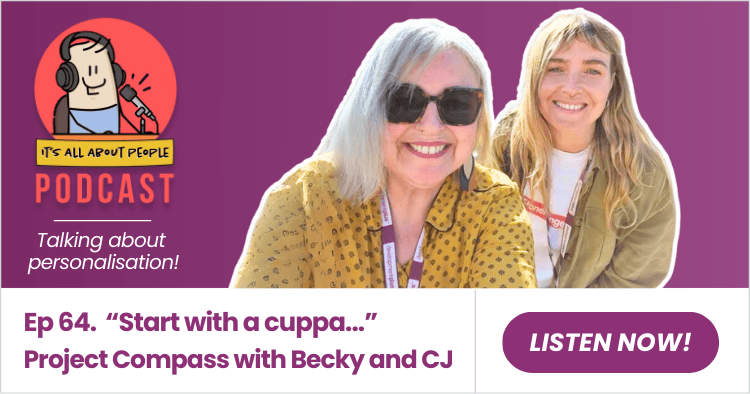
Project Compass: Walking with, not for people – Why personalised support matters
Project Compass is more than a day centre. It's a place where people experiencing homelessness can find warmth, advocacy, patience, and, crucially, a personalised approach that recognises their humanity and their readiness for change.
Meeting people where they are
One of the strongest threads that ran through Caty's conversation with Becky and CJ is the commitment to meeting people exactly where they’re at, rather than where systems expect them to be. This isn’t a slogan - it’s the practical, emotional foundation of their work.
Becky explained that individuals arrive with very different histories and needs, and that these differences shape what kind of support is possible:
“People come to us for a wide range of reasons… and that will affect their outcome really.”
Project Compass offers food, clothing, showers, and health support, but the team’s true focus is on empowering people to move forward when they are ready. That timing cannot be imposed:
“Some people really aren’t in a position where they’re ready to start doing that work… It’s not that we don’t care… but we have to wait until they’re ready.”
At the heart of this philosophy is a simple mantra: with, not for. Becky:
“We don’t do things for people… we do what we can with people, and we’re led by the people who come to us.”
This approach rejects the idea that professionals can or should “fix” someone. Instead, movement only happens in partnership - and only at the pace that feels safe for the person.
The power of advocacy and human connection
CJ describes advocacy as “the core principle” of their work, and emphasises just how transformative it can be when someone finally feels listened to rather than managed:
“We talk about advocacy a lot… it’s really important. Walking with somebody on that journey, not just saying, ‘Here’s the problem, I’m going to come up with a solution.’”
Much of this begins with something deceptively simple: a cup of tea. Before any assessments or difficult conversations, the first act is always human:
“Let’s just sit and have a cup of tea… a baseline start point where we can ground somebody.”
This gentleness helps people settle, feel safe, and realise they are not about to be judged or rushed. It is a deliberate slowing down of systems that often move too quickly for people in fragile situations.
Both CJ and Becky emphasise the art of timing - knowing when a hard conversation should happen, but equally knowing when it absolutely shouldn’t:
“Perhaps today isn’t the day… we often say that, don’t we? ‘Not today.’”
This sensitivity isn’t a luxury; it’s essential. Many people seeking support are navigating trauma, exhaustion, shame, or fear. Recognising this emotional reality is what makes advocacy effective.
A service built from listening
Project Compass itself grew out of a recognition that traditional services weren’t meeting people’s needs. Becky recounts how the project began with six months of meeting rough sleepers where they actually were - McDonald’s at 4am, street corners, doorways - simply to understand their lives:
“We tried to understand where they'd come from and what their ambitions were for their lives.”
That listening changed everything. It revealed a glaring gap in local support: people had access to a night shelter and to council housing assessments, but nothing in between. No safe day space, no place to wash, no relational support, no advocacy.
So Becky acted:
“I thought… it can’t be that difficult to provide somewhere for people to meet their basic needs… so I said, ‘If they’re not doing it, I’ll do it.’”
What began as “a flask and some cereal” is now a building, a staff team, and a network of wraparound professionals, from mental health nurses to drug and alcohol workers, who come to the Compass, instead of expecting people to attend intimidating appointments elsewhere.
Becky explained why that shift matters:
“I knew the guys would say, ‘I haven’t washed in weeks… how can I go to the GP?’… Project Compass is that safe space where those professionals will come to you.”
Again, the emphasis is on designing systems that adapt to people, not the other way around.
Success is personal, not transactional
When asked about success stories, both Becky and CJ resist the idea of dramatic transformations. Instead, they celebrate small, deeply personal shifts.
Becky: “It’s the small successes… sometimes the important stuff is that somebody didn’t die.”
A person agreeing to talk about their mental health, or simply staying alive through another winter, can represent profound progress. Some journeys take years:
“Sometimes that’s been 18 months, two years, longer… I’m really proud of how patient the team is.”
CJ echoed this, describing how unusual - and precious - it is to work somewhere that never gives up on people:
“There are too many places quick to write people off… but who knows? This might be the time when the change for you is now.”
The team’s ethos is unwavering: no matter how many times someone returns, they are welcomed.
CJ: “I opened the door and he said, ‘Sorry.’ And I said, ‘You have nothing to be sorry about… come in.’”
That unconditional acceptance is not just kind. It's a lifeline for people accustomed to rejection.
Holding space until people can hold themselves again
The idea of “holding space” became a powerful metaphor in the conversation. It captures Project Compass’s commitment to stability, presence, and patience.
People come back years later, sometimes with entirely different issues:
“They say, ‘I didn’t know who to go to, so I thought I’d come and see you.’ And that is so lovely because they trust we’re still holding space.”
The team sees their role not as rescuers, but as keepers of a safe, steady anchor point in people’s lives - a place where they can rebuild confidence until they are ready to move forward.
Conclusion: Personalised care is human care
Across every story and every quote runs the same truth: personalised support is not optional. It is the only approach that honours people’s dignity, complexity, and autonomy.
Project Compass works because it treats people as people, not problems to be solved or cases to be managed.
By waiting for readiness, offering warmth without conditions, adapting support to individual needs, and staying present over the long term, the team creates the conditions in which genuine change can take root.
In a world where many services are overstretched, transactional, or rigid, Project Compass models a different way, one rooted in compassion, patience, and partnership. And sometimes it all begins with something as simple and human as a cup of tea.
More about Project Compass
Following the report on homelessness in 2019, undertaken by Developmentplus, there was a clear need for a service that would fill the gap for rough sleepers. This included those who had been asked to leave hostels, prison leavers without accommodation, newly homeless people who had not yet been found (verified by P3), and rough sleepers who were not engaging in services were the target group.
There was a plan to find a place to meet, somewhere to have breakfast and a hot drink, an opportunity to wash and change, and most importantly, access to workers who could engage, support, and signpost this group.
Lincoln Baptist Church already had a community support group, which mostly worked with the homeless and those in local hostels. It offered a meal once a week and an opportunity to talk. The church was in an excellent position, geographically. It also had a large number of volunteers and a heart for working with those living on the streets.
In March 2019, what is now known as Project Compass, began. In the early days, it was a bowl of cereal, a cup of tea, and some basic signposting advice. The numbers grew from 5 or 6 to 20 or 30.
Currently, there are 5 paid staff offering support to get into housing, manage addiction, and other services. There are established links with the probation service and the police, the HHH (Holistic Health for the Homeless), mental and physical health nurses, We Are With You, and the council rough sleeper team.
Project Compass also offers:
- Somewhere safe and warm to rest
- A phone to use/phone charging
- Clean clothes
- Appointment reminders
- food bank referrals


