Shaping person-centred health and care in Lincolnshire: "It's how we do things around here!"
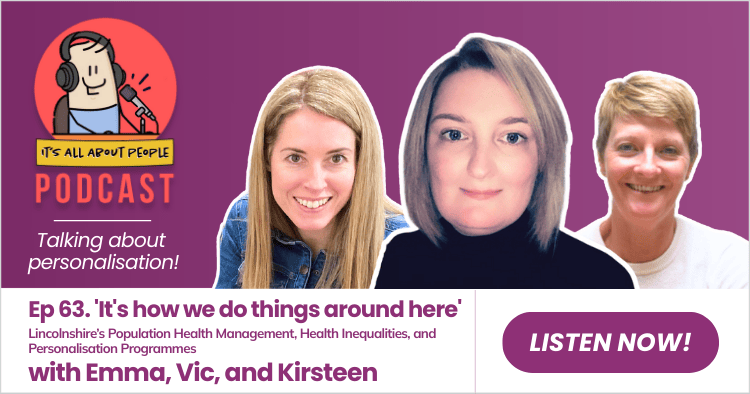
Health and care systems are full of ambitious strategies, clever models and well-intentioned programmes. But when three Lincolnshire leaders - Kirsteen Redmile, Vic Townshend, and Emma Townend - sat down with Alison for a lively It’s All About People podcast conversation, a shared truth ran through every story they told: real improvement only happens when we start with people, not processes.
Warm, funny and deeply human, their discussion explored three key enabling programmes shaping care across the county - Population Health Management (PHM), Health Inequalities (HI), and the It’s All About People Personalisation Programme. These approaches don’t sit in silos; they work because they work together.
By combining hard data with people’s voices, experiences and stories, the teams are building a richer understanding of what really matters to people in Lincolnshire and using that insight to shape care that’s fairer, more connected and truly person-centred.
Or, as Kirsteen, Vic, and Emma put it: "It's how we do things around here!"

CLICK ON THE IMAGE BELOW to hear our conversation with Emma, Vic, and Kirsteen
“It’s all about people”: Personalisation as the foundation
Kirsteen, Lead for Personalisation across the Lincolnshire Integrated Care System:
“It’s all about people and the language we talk about in terms of personalisation and strength-based practice… focussing on what matters to people means better outcomes.”
Personalisation isn’t a project - it’s a mindset. It’s “how we do stuff around here,” – it’s a shift away from service-led decision-making and towards conversations that genuinely reflect the context of people’s lives.
That shift matters. As Kirsteen noted, systems often chase the wrong outcomes:
“We point at how many people we can stop coming into A&E. But why are they coming into A&E in the first place? Do we understand that?”
A personalised approach uncovers the “why” - not just the symptom, but the story. And from there, the whole health and care system can respond differently, more humanly, and more effectively.
Intelligence for better decisions: Population Health Management
At the time of recording this podcast, Vic Townsend was Programme Manager for Population Health Management (PHM) and had recently completed a three-year programme embedding (PHM) in Lincolnshire.
Her role was to help the system understand what its 800,000 residents actually need - “intelligence-informed decision making, common sense and making decisions sometimes at scale.”
PHM doesn’t replace personalised care; it amplifies it. It connects the dots between individual stories and population-level patterns. It asks:
- Who is struggling most?
- Where are unmet needs highest?
- And importantly: is what we’re doing actually working?
As Vic explained:
“We don’t often really check that what we’ve decided to change has the benefit we think it should… Population health management closes out that cycle.”
At its best, PHM allows teams to identify groups with shared challenges – like back pain, frequent A&E attendance, or long-term pain medication - and design tailored, multidisciplinary responses. It moves care from reactive to proactive, from standardised to targeted.
Health Inequalities: Tackling unfair and avoidable differences in health head-on
Emma Townend is the Health Inequalities Improvement Manager for Lincolnshire Integrated Care Board (ICB), leading a programme rooted in a stark truth:
“Health inequalities are avoidable, unfair and systemic differences in health.”
In Lincolnshire, these differences are literally life-changing. There is a nine-year gap in life expectancy for men between the most and least deprived areas, and seven years for women.
Emma’s work ensures the system doesn’t settle for improvements that benefit only some. She frequently applies what she calls a “deprivation lens”:
“We can put something in place, and it does work for parts of the population, but… the ones who need it most are the least likely to come forward and access it.”
This phenomenon - the inverse care law - is why Personalisation and PHM matter so deeply. Without understanding people’s contexts, services risk unintentionally widening gaps.
A shared language: Breaking down barriers between services
One powerful theme from the discussion was the value of a common methodology. When Personalisation, PHM, and Health Inequalities become universal building blocks, teams across health, social care, and voluntary organisations have a shared starting point.
Vic describes the difference this makes: “No one comes into the room thinking, ‘I don’t know why I’m here’… Your dialogue can be richer, more quickly, rather than people coming with that organisational badge.”
This is culture change - not top-down, but grounded in shared purpose, shared understanding, and shared language. It enables genuine collaboration, with people with lived experience included as equal partners at the table.
Real-world change: From letters to Joint Aches & Pains Hubs
The conversation was full of practical examples - big and small - of how the three programmes work together.
Fixing confusing letters
Sometimes the most powerful change starts with the basics.
Emma and Kirsteen recently reviewed letters sent from the Elective Activity Coordination Hub. At one stage, people were receiving two letters in the same envelope, one telling them to ignore the other.
By applying principles of health literacy and accessible language, they’re helping redesign communications so everyone, especially those most at risk of misunderstanding, can navigate their care with confidence.
The Grantham Joint Aches & Pains Hub
At the other end of the scale is the Grantham project, a flagship example of what happens when these approaches align.
PHM identified people on long-term pain medication, often also juggling weight challenges or long waits for joint surgery. By bringing physios, clinicians, and personalised care teams together - and crucially, inviting people in for conversations - the hub gave residents a simple, human gateway to support.
It also built relationships between professionals who, remarkably, had never met despite working with the same people.
The result? More appropriate referrals, better preparation for surgery where needed, and people accessing help they didn’t know existed.
Designing services that don’t leave people behind
Emma repeatedly raised a challenge that applies to every health system:
Equal services are not necessarily equitable.
A service open to all might still benefit some groups far more than others. Only by reviewing uptake, outcomes and patterns through a health inequalities lens can teams ensure fairness.
“If we don’t look at that, the gap will widen.”
And this is exactly why the three programmes working together is making a real difference: personalised conversations reveal barriers, PHM shows who’s missing out, and the inequalities programme pushes for targeted action.
What happens if this work stops?
As Vic’s three-year programme concludes, she offered a candid reflection on the risks of stepping back: “You’d end up with a mismatch between what we’re delivering and what people actually need.”
Without PHM, Personalisation and a focus on Health Inequalities, the system risks:
- wasting money
- frustrating staff
- delivering ineffective support
- and ultimately worsening outcomes
“Population health management is common sense… We point everything we have at the right things for the right people.”
Conclusion: A person-centred approach for people
The energy between Kirsteen, Vic and Emma reflects something powerful: a culture shift is underway.
Their work shows that when systems listen - really listen - to people’s needs, stories and contexts, care becomes not only more compassionate but more effective. When data, personalised conversations and an inequalities lens come together, services become smarter, fairer and more human.
And ultimately, that is the vision they share: a health and care system where how we do things around here always starts with people.


