Working towards person-centred language in health and care
Over the past year, the It’s All About People Personalisation Programme team has been looking closely at the language we use and how it shapes relationships between services, people who draw on care, and their families – find out more about our language journey to date here: Gloriously ordinary language
We’re not doing this alone. Colleagues across the health and care system, alongside members of the public, are also working to improve how we communicate.
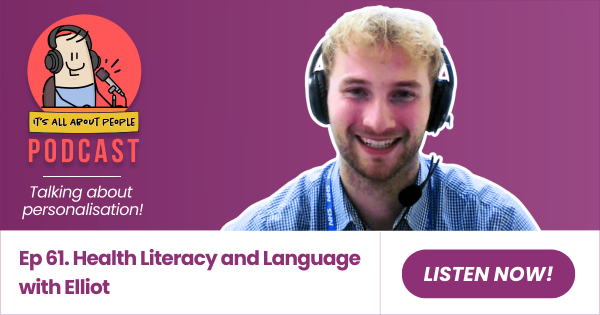
In August 2025, Alison spoke with Elliot Kane, General Practice Assistant at Brant Road Surgery, about why communication sits at the heart of safe, compassionate and personalised care. Together, Elliot and Alison explored what health literacy really means, why it matters more than ever, and how small changes in language can make a big difference to understanding, trust and confidence.

CLICK ON THE IMAGE BELOW to listen to Alison's conversation with Elliot
Health has a language of its own
One of the biggest barriers people face in healthcare is the language itself.
Elliot: “Health literacy is the ability to understand and use information to make informed decisions about health and healthcare… the language of health is its own language.”
While many professionals grow used to phrases like “analgesic”, “hypertension”, or “PRN”, for most people, these terms might as well be code. And often, they are.
Even Alison, who works in the health and care system, realises she struggles with words used daily in clinical settings:
“If this is difficult for you then you can imagine it's going to be very difficult for someone that's not in the system at all.”
This kind of linguistic mismatch isn’t harmless. It can create fear, confusion, and distance. It can lead to missed appointments, wrong assumptions, unsafe decisions, or no decisions at all.
Elliot backs this up with striking statistics:
"61% of adults cannot understand health information that includes both words and numbers. Just over half of our population aren’t fully understanding the information that we give to them.”
In a system built on the idea of informed consent, shared decision-making, and patient empowerment, this creates a deep ethical issue.
How can patients consent to something they don’t fully understand?
Language shapes relationships
Another theme Elliot and Alison explore is how language affects the dynamics between professionals and patients. When clinical language becomes too technical, it inadvertently creates a hierarchy.
Elliot:
“Neglecting health literacy… makes that relationship quite hierarchical… patients feel a bit silly asking for clarification.”
This feeling - "I don’t understand, so I shouldn’t ask" - is one of the biggest barriers to personalised care. It stops people from saying, “I’m confused,” “I’m worried,” or “Can you explain that again?”, even when their health depends on it.
Alison: “It turns us into the us and them… it makes you look really smart, and me feel really dumb.”
This dynamic isn’t just uncomfortable - it can be dangerous. When people leave a consultation unsure what has been said, they may mismanage medication, miss appointments, or turn to Google, which can increase anxiety further.
Personalised care relies on mutual respect and understanding. And that begins with clear, human, everyday language.
Personalisation begins with understanding
A personalised approach to care isn’t possible if people can’t understand the choices available to them.
Elliot:
“Health literacy is the foundation of personalisation… you need to be able to understand the options that are presented to you.”
This extends beyond reading ability. Even people with strong literacy skills can struggle when they’re stressed, unwell, or facing complex decisions.
Alison: “In times of crisis… you’re not necessarily taking it in or processing it.”
No one is immune to poor health literacy in moments of vulnerability.
Personalised care requires us to see the person, not just assume their capacity. It requires us to ask: How can I make this easier? More human? More relevant to you?
Simple changes, big impact
Elliot shared an example that perfectly captures the power of personalised communication: a Romanian patient with uncontrolled diabetes and high blood pressure. His English was good, but not when it came to complex diabetic information.
The turning point?
“The diabetic nurse… translated the information into Romanian… and with that his diabetes and blood pressure began to improve.”
This wasn’t a change in medication, equipment, or treatment. It was simply presenting information in a way the patient could understand.
The message is clear: when people understand what’s happening, they can take action.
When they don’t, their health can suffer.
System change starts with everyday words
Much of Elliot’s work at Brant Road Surgery in Lincoln focuses on rewriting preset communications - text messages, letters, online consultation prompts - to reduce their reading age from 21.
Elliot: “We’ve brought the average reading age down to 10 or 11… with no message higher than 12.”
This is a significant shift. It means more people can understand messages first time. It reduces anxiety, confusion, and phone calls asking for clarification. And in time, Elliot hopes it will increase early responses to appointment recalls, improving long-term condition management.
The tools used - AI readability checkers, co-production with patients, and simple language training - show that personalised communication is both achievable and scalable.
Elliot:
“The adjustments you have to make aren’t all that big or difficult, but the downstream effects… are absolutely massive.”
Towards more human, and truly shared, conversations
At the core of Alison's conversation with Elliot is a vision for more equal, human interactions in healthcare. Health professionals remain experts in diagnosis and treatment, but patients are the experts in themselves.
Alison: “You’ve got two experts in that room… we need to change those relationships.”
Elliot agrees, emphasising that shared decision-making can only happen when both parties understand each other. Techniques like “chunk and check”, “teach back”, and the “dinner table test” are simple ways to ensure information lands clearly and respectfully.
This shift - from 'telling' to 'working in partnership and sharing information' - is the essence of personalised care.
Conclusion: Health literacy is personalisation in action
What Elliot and Alison highlight is that personalisation begins with the words we choose and the relationships we build. It’s about recognising that everyone deserves to understand their health, their choices, and their care, not just those comfortable with medical terminology.
When we use language that includes rather than excludes, we remove barriers. We build trust. We give people power over their own wellbeing. And in many cases, as Alison notes from a story she heard:
“One sentence changed my life… saved my life.”
Personalised care starts with real conversations between people. And as this conversation shows, that simple shift has the power to transform not just services, but lives.


