26th November 2026
Personalised care in neighbourhood health: the real change starts with how we work together
Personalised care has the power to transform neighbourhood health, but only if we are prepared to change more than structures and services. It asks us to rethink a relationship built over generations: moving from doing things to or for people, towards working with them as equal partners, recognising their strengths, knowledge and expertise in their own lives.
Last week’s announcement at The King’s Fund Annual Conference by the Health and Social Care Secretary Yvette Cooper sets out an ambitious vision: Neighbourhood Support Teams providing earlier, coordinated and personalised care for people most at risk of hospital admission.
The plans promise a dedicated team, a single point of contact and one care plan built around the person. This is a welcome step towards proactive, joined-up care closer to home.
Yet the stories shared at our recent It’s All About People Personalisation Huddle, ‘It’s all about relationships’, were a timely reminder that this ambition will only succeed if we invest in the human relationships that make personalised care possible.
So, as I reflected on the announcement, one question stayed with me:

What will it really take to work with people in this way?
Strategies and frameworks can describe the destination, but they rarely say enough about the human change required to get there. This is not simply a new service model. It is a fundamental change in the relationship between people, communities and the health and care system.
Moving from 'fixing' people to working alongside them.
For many years, health and care have focused on identifying what is wrong and deciding how professionals can fix it. This has usually come from a place of care and compassion. We want to help, protect people and reduce risk.
But sometimes in trying to help we can take over, focus on deficits and overlook people’s strengths, experience and potential. We can make decisions about people without fully recognising the knowledge they bring to the conversation.
Personalised care asks something different of us.
It asks us to recognise people as experts in their own lives. They understand their families, communities, priorities, fears and aspirations in ways that services never fully can. They bring skills, relationships and lived experience that should be valued alongside professional and clinical expertise.
This does not mean leaving people to manage alone. People have different levels of confidence, knowledge, resources and opportunity to look after their health and wellbeing, and our responsibility is to provide the right support.
It means starting from a different place:
What matters to you? What strengths do you already have? What would help you feel more confident? And what can we do together?
Personal accountability without support risks becoming blame. With the right relationships and resources, it can build agency, confidence and independence.
A neighbourhood team is more than a group of professionals.
Bringing professionals together does not automatically create an integrated neighbourhood team.
People can share a building, attend the same meeting or use one care plan while still working within different cultures, professional languages and organisational expectations and priorities.
Teams need a shared understanding of personalised, strengths-based practice, alongside the confidence to have different conversations, share decisions and work with uncertainty. They also need time to reflect and challenge established habits safely.
This is the gap we must not overlook. If we create new neighbourhood structures but do not build the capability and capacity of the workforce, we risk recreating traditional models of care within a new organisational wrapper.
We need to prepare the public as well as the workforce.
There is another part of this change that deserves equal attention.
If we want a new relationship between people and services, we need to work openly with the public about what that relationship means.
For some people, personalised care means greater choice and control. For others, it means support to manage a condition, connect with local networks or recognise when to seek help.
This cannot be communicated as services stepping back, particularly when poverty, poor housing, caring responsibilities, limited health literacy, digital exclusion or isolation restrict people’s choices.
It must mean services working differently: intervening earlier, building confidence, connecting people with support and standing alongside them when more help is needed.
True personalisation is not about asking everyone to do more for themselves. It is about discovering what each person can and wants to do, understanding what may be getting in the way, and agreeing the right support together.
The implementation bridge already exists in Lincolnshire
This is where the It’s All About People Programme has such an important role to play.
We’re not a separate initiative sitting alongside neighbourhood health. We provide practical support and can be a critical friend when striving to make neighbourhood care genuinely personalised.
At its heart, Our Shared Agreement provides a relational foundation: understanding what matters, having conversations with people rather than about them, working together and making the most of people’s and communities’ strengths.
Like many experienced professionals, Kate, an Advanced Clinical Practitioner at Trent Primary Care Network came to her first IAAP Personalisation Huddle believing that person-centred working was already central to her practice:
“I remember sitting there thinking, ‘But I already do this.’”
A conversation about a person living with epilepsy became what she described as a 'bombshell moment'. It helped her recognise that, despite always striving to put patients first, her thinking was still rooted in a traditional medical model:
“I’m not actually as person-centred, truly person-centred, as I thought I was.”
Kate’s honest reflection captures the difference the IAAP Programme can make. We don’t simply introduce new tools and resources. We create the conditions for people to question long-established assumptions, see practice through a different lens and make lasting changes to how they work alongside people.
Our offer helps to translate those principles into everyday practice through our IAAP Operating Model.
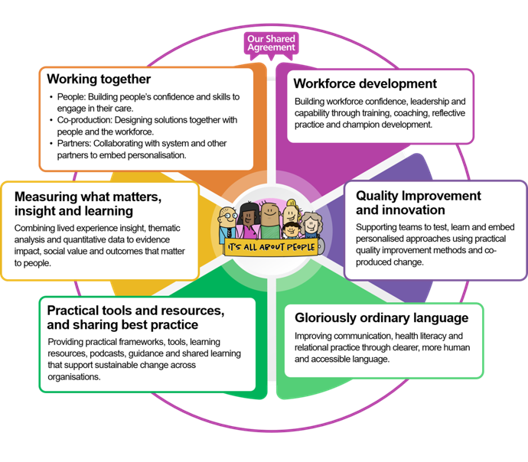
The model brings together six interconnected areas that support improvement, partnership working, workforce development, co-production, community engagement and measuring impact, and as the team we act as a system-wide enabler by connecting partners, building capability, sharing learning and providing specialist support where needed.
In Lincolnshire, this bridges system ambition and neighbourhood delivery by helping to build a shared relational culture across health, care, public health and the voluntary, community, faith and social enterprise sector.
We can support neighbourhoods to involve residents and carers early, build workforce capability, connect with community strengths and combine operational data with lived experience.
Relationships are already changing outcomes in Lincolnshire
Our recent IAAP Personalisation Huddle brought this to life. Colleagues shared examples of how trust, curiosity and listening to what matters are already improving outcomes in primary care, neighbourhood teams and communities across Lincolnshire.
Kate, an Advanced Clinical Practitioner in Trent Primary Care Network’s Age Matters team, described how understanding a 92-year-old man’s priorities transformed his care. Rather than repeatedly responding to test results and hospital appointments, the team organised support around the life he wanted at home with his wife: “I’m not treating numbers, I’m treating people.”
Rachael, a care coordinator, shared how listening and offering choice changed an encounter with a man living with dementia who had expected to be told what he ‘must’ do. His response was powerful: “You make me feel like a person.”
Amy, a Health Inequalities Link Worker, challenged the idea of ‘hard-to-reach’ communities. As one member of the Traveller community told her: “We’re not hard to reach. We’ve been here for years.” Her work shows how going to where people are, turning up consistently and building on trusted community relationships can reduce barriers and health inequalities.
None of these examples began with a new pathway or structure. They began with a human connection: being present, asking a different question, listening and following through. That is the relational practice at the heart of Our Shared Agreement and IAAP, and a strong foundation for personalised neighbourhood health in Lincolnshire.
The opportunity in front of us
The national announcement creates real momentum. But the success of neighbourhood health will not ultimately be determined by the number of teams established, meetings held or care plans completed.
It will be determined by whether people experience something different.
- Do they feel heard?
- Do they understand their options?
- Are decisions made with them?
- Does their care reflect what matters to them?
- Are their strengths recognised?
- Do staff have the confidence, skills and permission to work in this way?
- And are we learning from people’s experiences when the system gets it right, and when it does not?
This work challenges years of culture and expectation. It asks professionals to share power, organisations to work beyond boundaries, and all of us to think differently about responsibility, risk and what it means to help.
But in Lincolnshire, we are not starting from scratch.
Through the IAAP Programme and Our Shared Agreement, we already have strong foundations: shared principles, practical tools, workforce development, community insight and a growing network committed to changing how we work together.
The national vision has described where we need to go.


