Personalisation driving Adult Social Care in Lincolnshire
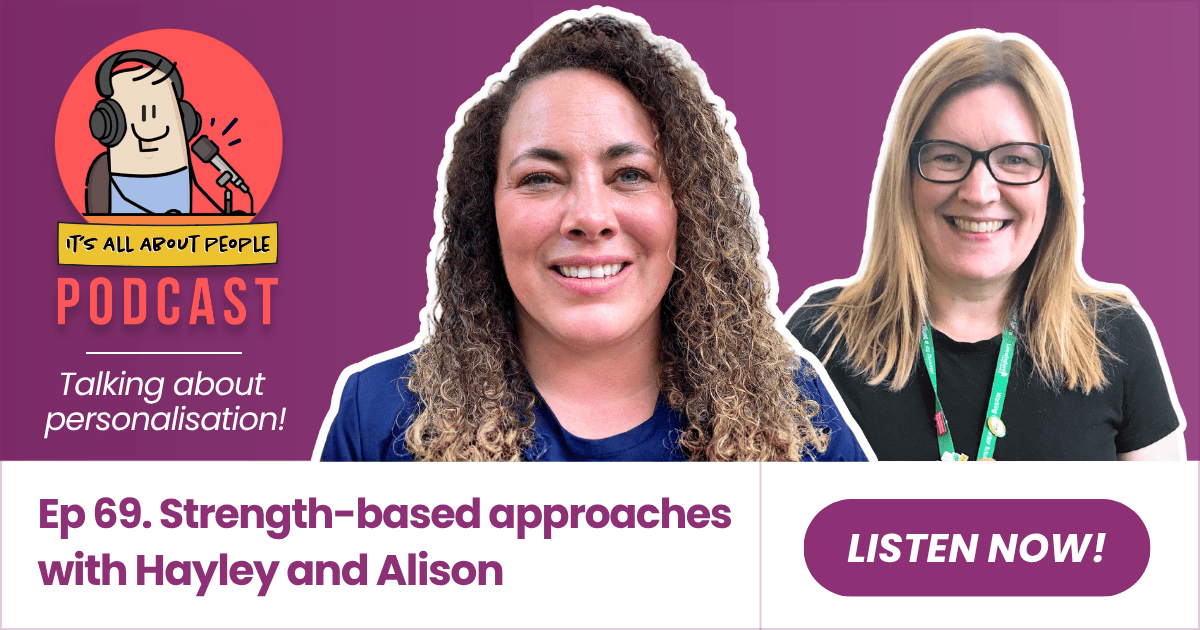
In October 2025, Alison from the It’s All About People team sat down for a chat with Hayley Eccles, Deputy Director of Adult Social Care at Lincolnshire County Council, to explore how a strengths-based mindset transforms the way we think about care and support.
The conversation offered a powerful reminder of what truly sits at the heart of social care: people, their strengths, their stories, and their aspirations. Throughout the discussion, themes of personalisation, community, collaboration, and culture change shine through. Hayley’s reflections - shaped by her own journey from Support Worker to Deputy Director - brought these ideas vividly to life.

CLICK ON THE IMAGE BELOW to listen to Alison's conversation with Hayley
Care begins with people and their stories
From the outset, Hayley emphasises the human foundation of social care, reminding us that the purpose of the profession is never abstract:
“100% of the people that we serve are people, 100% of our workforce is people. So you have to care about people.”
It’s a simple statement, but an important grounding. In periods of significant pressure - growing demand, stretched teams, complex cases - it can be easy for systems and processes to overshadow the individuals at the centre of the work. Yet Hayley insisted that the profession must continually return to the person behind every referral, assessment, or conversation.
Her own career path, starting as a support worker and continuing through to qualified social worker and senior leader, clarifies why she holds this view so firmly:
“I know how it feels to walk in people’s shoes… Those years working with people built my character and what I do.”
This lived experience, she says, is what keeps her grounded in empathy and authenticity. It also informs her belief that personalised, relationship-led work is vital to achieving meaningful outcomes.
Seeing strengths, not deficits
A major focus of the discussion is strengths-based practice, a model that moves away from assessing what people can’t do, and instead explores what they can do, what matters to them, and who and what is already in their life that can support them.
Hayley: “Everybody has strengths… the ability to be really resilient, the ability to be stubborn sometimes with your independence. It’s about building on those strengths and those circles of support.”
Strengths-based practice challenges the traditional “fixing” mindset of health and social care. Alison highlights how services have historically positioned themselves as problem-solvers:
“People come to us and think, oh, they’ll be able to fix it… But, actually, that’s not what people want.”
Instead, people want support that honours their priorities, their identity, and their goals, no matter how small or simple those goals might seem. Alison shares the story of someone who simply wanted to walk their dog to the end of the street, not complete a long clinical checklist.
Strengths-based practice is an antidote to this kind of one-size-fits-all thinking. It requires workers to have conversations with people, not about them, creating space for the person to lead the conversation about their own life.
Personalised care requires true partnership
Another theme woven throughout the conversation was partnership - across organisations, sectors, and most importantly, with people who draw on care and support.
Hayley is clear: personalised care can only happen through collaboration.
“Adult social care isn’t the answer to all of that… There is massive support in our communities… and we need to key into that.”
She describes the informal networks - family, friends, neighbours - that most of us rely on in tough times. When she asked a room of professionals how many had come home from hospital with a package of care, no one raised their hand. Support was instead provided through those natural circles of support.
So why, she asks, don’t we start by taking the same approach with the people who use services?
This requires partnership not just with communities but with NHS Lincolnshire, the Voluntary, Community, Faith and Social Enterprise Sector (VCFSE) and other organisations, especially as new neighbourhood-based models develop.
Hayley stressed that avoiding fragmentation is key:
“It’s about the person not being pulled in the middle, but the person at the heart of everything that we do.”
Creating a culture that gives permission to work differently
A strengths-based approach is as much about mindset as it is about method. Both Hayley and Alison acknowledged that change takes confidence, trust, and professional freedom. Hayley highlighted that consistent practice in Lincolnshire is still developing:
“Is it embedded and consistently applied as we would like? I would say probably not. And there’s ways that we can build on that.”
Changing culture means encouraging staff to question assumptions:
- “Is this the least restrictive option?”
- “Is this proportionate?”
- “Is there another way to meet this need?”
- “Are we building on the person’s strengths or simply defaulting to what we’ve always done?”
To support this, Hayley described creating “communities of practice” where colleagues can explore, challenge, and learn from each other. These forums are about building shared confidence to practise differently, rather than waiting for top-down instruction.
Alison reinforced the importance of permission:
“We don’t have to do things the same way as we’ve always done it… It’s having that confidence and that permission to do things differently.”
This shift is not just internal. It also depends on communicating openly with communities about why the approach is changing, what it means, and how it will help people live independent, connected lives.
Listening to lived experience as a driver of change
Perhaps the most powerful message is that the voices of people with lived experience must guide improvement. Hayley is clear that real stories, not policies, are what change beliefs and behaviours:
“The best way… is not to listen to me, it’s to listen to the people that we support… When they see and feel the difference it makes to somebody’s life, then they believe it.”
Both Hayley and Alison emphasised the need for co-production, not consultation after the fact. Strengths-based work cannot be designed in isolation from the people it affects.
They also highlighted the importance of celebrating success - an area social care often overlooks.
As Alison noted, the sector “gets a bad press,” but many uplifting, innovative examples already exist across Lincolnshire. Sharing these stories builds momentum and pride and shows that personalisation is achievable.
Conclusion: A shared commitment to person-centred care
This conversation reaffirms that personalised, strengths-based care is not a “model” or a “programme” - it’s a mindset, a culture, and a commitment. It is rooted in listening deeply to what matters to people, seeing their strengths rather than their deficits, recognising the power of communities, and working collaboratively to support independence and wellbeing.
Hayley is bringing this vision to life with clarity and passion. Her commitment is unmistakable:
“This is about people getting the best possible outcomes… and I’m so excited to meet Lincolnshire where they are and start building on that journey.”
Ultimately, personalised care is not an aspiration for the future - it's something that can be built now, through everyday conversations, shared decisions, and an unwavering belief in people’s strengths.
Lincolnshire’s challenge, and its opportunity, is to embed this approach consistently and confidently across the county. As both Hayley and Alison remind us, when we put people at the heart of what we do, we cannot go far wrong.


